

In this article

For a pre-IPO CFO, the pitch deck is both a fundraising document and a governance signal. According to Wilson Sonsini's 2024 IPO Report, 63.6% of last year's IPO cohort did not disclose key metrics in their S-1 filings, a gap that starts showing up long before the S-1 stage. Automated AI governance platforms help show institutional investors and underwriters that the story in your deck is backed by consistent board materials and an audit-ready record that includes reviewed risk language. A deck stitched together from scattered board decks and out-of-date spreadsheets tells investors something about your governance long before anyone reaches the financials slide. For a founder or CEO steering the company toward a raise, that answers a question they can't resolve alone: whether the governance infrastructure will hold up under public-market scrutiny.
This guide explains how governance-ready pitch decks come together:
An automated AI governance platform synthesizes board materials into consistent first drafts, scans for legal and compliance risk and maintains tamper-proof audit trails within one system.
That governance signal starts with the board itself, not the deck. Investors want to see that a board has honestly sized up its own capacity to oversee complex, fast-moving risk, AI oversight increasingly among them. Keith Enright, VP and Chief Privacy Officer at Google and Board Director at ZoomInfo, frames that as a discipline boards often skip: "Have a candid assessment of what your board's capabilities are… The board needs to apply an appropriate level of governance pressure to someone who's going to oversee the AI landscape, the risk exposure, the disruption and the opportunity." A board that has actually done that work produces materials that hold together under scrutiny. Readiness for a raise depends on that same consistency: board materials, investor-facing disclosures, risk review and audit trails all telling the same story. That capability gap isn't unique to any one region: Diligent Institute's APAC Governance Outlook 2026 found that 70% of boards cite agentic AI opportunities as their top upskilling priority, ahead of every other capability gap surveyed.
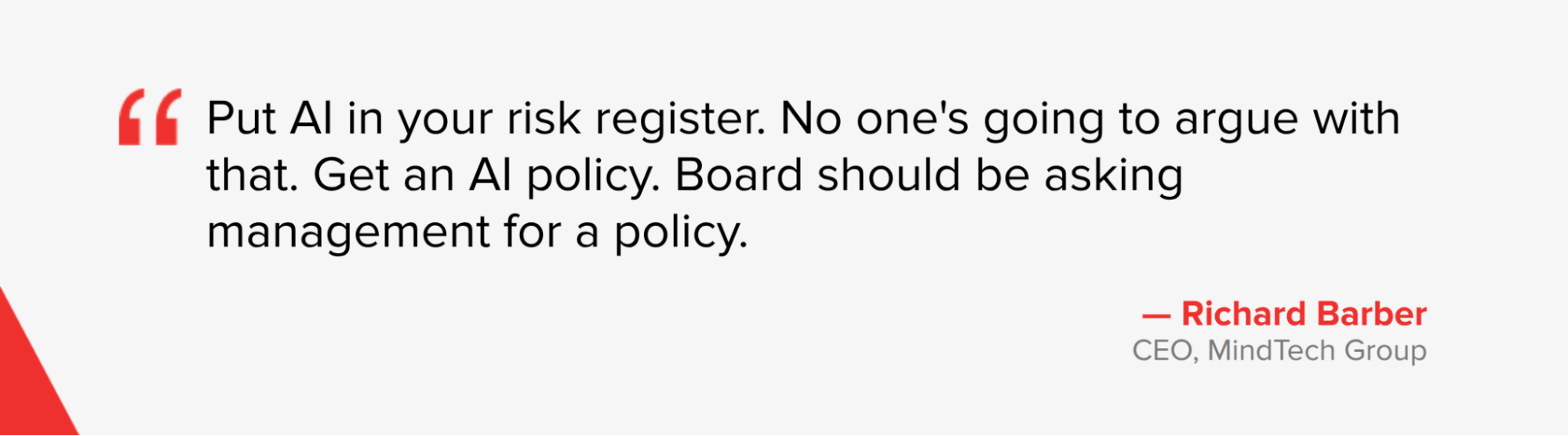
According to a PwC study, an average of 46% of companies disclosed at least one material weakness while going public over the 2019–2024 period, a governance and disclosure gap institutional investors now expect companies to close well before a raise. Richard Barber, CEO at MindTech Group, argues the first move doesn't need to be complicated: "Put AI in your risk register. No one's going to argue with that. Get an AI policy. Board should be asking management for a policy." That kind of low-friction step is exactly what starts closing the gap PwC is tracking, well before a diligence team goes looking for it.
Finance and governance leaders at pre-IPO companies feel that pressure most during raise preparation. Manual board book processes often require teams to rebuild materials before each raise. General counsel teams focus on keeping unreviewed risk language out of investor materials. CEOs want to know whether the company's governance will hold up when investors start pulling on threads.
You're building the record that underwriters, auditors, institutional investors, board administrators, the head of investor relations and external IPO counsel will pick apart during diligence. Many pre-IPO companies do that without dedicated governance staff and while running the business. Automated AI governance platforms address this gap by turning manual, inconsistent board processes into documented, repeatable workflows that produce investor-ready materials. The pitch deck then shows governance maturity instead of exposing gaps.
Investors read pitch decks for governance signals as well as narrative: whether the numbers reconcile with board-level reporting and whether risk language matches what will appear in the prospectus. They also look for board and audit committee structures that meet sophisticated investor expectations. These cues tell an experienced analyst whether your governance infrastructure was built for internal convenience or institutional scrutiny.
Investors base an average of 40% of their IPO investment decisions on non-financial factors, including governance and the quality of management and operations, according to EY. Treat your board book and investor deck as a single record: reconcile every projection to board-level reporting before it reaches an investor, and make sure the version an analyst sees matches the version your board approved.
An AI governance platform built for board work keeps materials in one system. That gives you a single source of truth and forensic audit trails, with document-level access controls that generic file-sharing tools were never designed to produce. It separates investor-ready governance from a folder of documents you hope reconciles under pressure.
Some slides carry more governance risk than others. These four are where inconsistencies between your internal record and your investor-facing materials surface first, and where diligence teams concentrate their attention.
Manual assembly creates the most damage on the financials slide. When board-level reporting and investor-facing projections live in separate systems, version drift is almost guaranteed. Projections that conflict with audited statements or your 409A valuation create real liability, so every number needs to trace back to a single, board-approved source.
Investors check your team slide for governance structure as well as resumes: a majority-independent board, audit committee plans and plans for compensation and nominating committees. SEC Rule 10A-3 and exchange rules require an independent audit committee soon after listing, and Regulation S-K Item 407 governs audit committee financial expert disclosure. Companies should not wait until the last minute to begin the search for qualified outside board members.
Risk language that reaches investors without review is one of the most avoidable governance failures. Road show and pitch deck communications must not go materially beyond the preliminary prospectus, because misleading statements or omissions create direct liability. A documented, AI-assisted review step counters the inclination to soften or omit disclosures before they reach the board level. Review this content for legal and compliance exposure before anything is distributed.
Institutional investors want evidence of board oversight: documented committee structure and decision trails, backed by defensible governance policies. Dual-class share structures and classified boards can draw investor and proxy advisor criticism when they lack a reasonable time-based sunset, so document your oversight so the story on the slide matches the record behind it.
Explore how growth-stage companies prepare for funding rounds and exits.

Governance-ready means your materials can withstand institutional scrutiny because the infrastructure behind them is consistent, documented and auditable. An AI-powered approach makes that state achievable without a large governance team. A practical checklist for automated AI governance platforms includes:
Each capability closes a specific documentation gap between informal governance and the institutional record investors expect. In practice, that might mean reconciling an audit committee packet against the same financial model your team will use in an S-1 drafting session, then recording reviewers and material changes before the board approves them.
Governance-ready infrastructure earns its value in the moments where manual processes break down. These use cases matter most as you prepare to raise or exit, because they turn automated platforms from productivity tools into governance infrastructure for pre-IPO companies.
Board books and investor decks often fail to reconcile. Automated materials assembly keeps both grounded in the same source data, so internal reporting and investor-facing projections stay aligned before every raise. The Transaction Readiness Report by Diligent Institute, Wilson Sonsini, NetSuite, CFO Alliance and CFO Leadership Council found that only 4% of organizations have fully integrated GRC and financial systems. That gap isn't isolated to transaction-specific systems either: Diligent Institute's GC Risk Index 2026 found only 19% of organizations report fully integrated governance, risk and compliance systems overall. Use that as a diagnostic: before investor outreach, map where board reporting, financial models and diligence evidence live, then prioritize the highest-risk handoffs.
Before any material goes to investors, it should pass a review for legal red flags and disclosure gaps, especially wording that conflicts with your prospectus. AI risk scanning catches problematic content early. Correcting it then is inexpensive; late correction can threaten the deal.
Institutional investors expect documented committee independence and clear governance policies with financial-literacy evidence. The NYSE rules and Nasdaq rules include tight phase-in windows for full audit committee independence, so document committee structure and financial-expert qualifications as you form the committee. Gaps identified late in an S-1 process are often the ones most likely to slow or complicate a deal.
When a raise or exit begins, investors expect organized evidence packages with secure, permissioned access. A secure data room produces these fast, with tracked document views, enforced NDAs and watermarking.
Underwriter counsel reads every board minute looking for material events and governance gaps, and sparse minutes draw extensive comments. A minute noting that independent directors reviewed comparables and assessed conflicts before voting carries far more weight than one stating the board simply approved.
What Directors Think 2026 by Diligent Institute and Corporate Board Member reports what board members need from governance infrastructure ahead of a raise or exit.
See how Assore Holdings cut board prep time by up to 60%, then download What Directors Think 2026 for the data behind board-ready governance.

Automated platforms built for board work address consistency and risk review while preserving audit trails. Boards need AI that understands regulatory obligations and governance processes. According to What Directors Think 2026 by Diligent Institute and Corporate Board Member, 40% of directors want access to AI-powered technology for board work and oversight. If you're shortlisting platforms for boards, focus first on contextual risk review and director prep. Document synthesis should also be evaluated against board-book workflows.
Diligent Boards, part of the Diligent One Platform, applies AI capabilities to these governance bottlenecks:
Each organization's data stays separate and is never used to train shared models. Reliable underlying data builds trust, which is the signal institutional investors read in your materials. That matters because reliable data lets executive teams discuss risk and reach decisions without debating the integrity of the materials.
Implementation complexity and cost versus headcount are common objections, especially when teams need to fit existing board workflows. A phased setup addresses those concerns by starting with board book assembly or pre-distribution review, then expanding into secure diligence workflows. Diligent Data Rooms support that next step by connecting transaction materials to the governance record with granular permissions and audit trails that track activity.
For teams evaluating the board-preparation workflow itself, Assore Holdings saved up to 60% of board meeting preparation time using Diligent Boards' Smart Builder, SmartPrep 360 and Smart Risk Scanner. Lean pre-IPO teams can reduce manual preparation, manage last-minute changes and surface risk questions faster when a raise or exit tightens the timeline.
Assore Holdings Proprietary Limited, a fast-growing international mining company, faced the same governance strain many pre-IPO teams recognize: manual board preparation, version control issues from last-minute changes and difficulty surfacing insights quickly for leadership as the company scaled globally. After adopting Diligent Boards' Smart Builder, SmartPrep 360 and Smart Risk Scanner, the company cut board meeting preparation time by up to 60% and shifted board discussion from simple approval toward substantive comment on resolutions. "The capabilities provided by Diligent's GovernAI have contributed substantially to achieving this aim," says Janine Govender, Group Company Secretary at Assore Holdings.
Telepass, a European digital mobility and toll-collection company, needed a single source of truth across audit, risk and compliance rather than guesswork stitched together from disconnected systems. Using Diligent One Platform, Telepass reduced action follow-up time by 50% and built the comprehensive board-level reporting that lets its team move from anecdote to evidence. "The power of analytics allows us to move beyond guesswork and provide concrete, data-backed answers," says Michele Variale, Chief Audit Executive at Telepass, in the Telepass case study. For pre-IPO teams building investor-ready governance, both examples point to the same lesson: the platform pays off well before the raise, in the discipline it builds into everyday board and risk workflows.
If you're preparing for a raise, sequence matters. The EY guide to going public and PwC analysis of IPO material weaknesses point to the same planning horizon: readiness needs to begin before formal IPO execution. Working backward from that horizon gives you a practical maturity path, including the following:
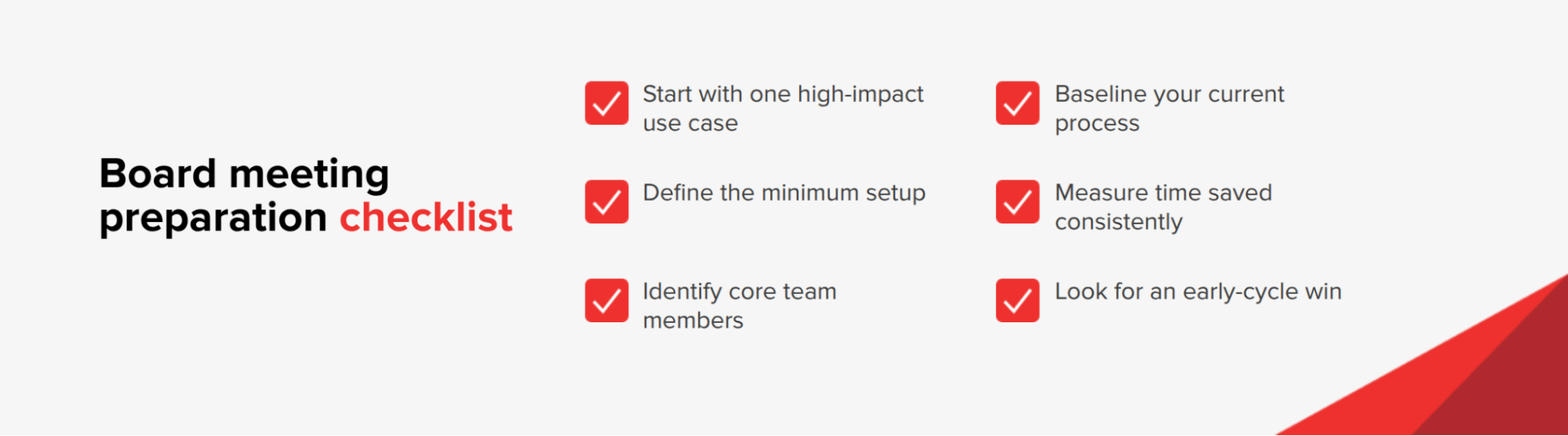
Start with one high-impact use case and prove value fast. For most pre-IPO companies that means board book assembly before the next raise, or risk scanning before investor distribution.
Define the minimum setup: which workflows you're targeting, such as board prep and risk review, and whether data room production belongs in the first phase. The core team typically includes the CFO, general counsel, board administrator, head of investor relations and external IPO counsel.
An early-cycle plan can begin with a baseline of your current process and turnaround times, followed by implementation across the next one or two board cycles. Measure time saved and consistency improvement against your baseline, and look for an early win in the first cycle. Value compounds from there: every subsequent board cycle strengthens the record institutional investors will eventually inspect.
An automated AI governance platform synthesizes source documents into an accurate first-draft board book, enforces document-level access controls, maintains tamper-proof audit trails and supports secure investor data rooms inside one infrastructure platform. Generic document tools handle storage and version history, but they leave the workflow around the documents, including risk review, permissioned distribution and reconciliation between board materials and investor-facing decks, entirely to people. A governance platform builds that workflow into the system itself, so consistency doesn't depend on someone remembering to check.
For pre-IPO teams, yes: specialist software replaces the manual assembly and version-control work that SharePoint and Google Drive leave to people. Those general-purpose tools were never designed to produce the forensic audit logging and permissioned distribution institutional investors expect during diligence, and they don't reconcile board materials against investor-facing projections automatically. Teams that move off shared drives typically see the biggest gains in reducing the time spent rebuilding materials before each board cycle or raise.
They keep your board book and investor deck grounded in the same source data, so projections and disclosures stay consistent between what the board approved and what an analyst sees. Pre-distribution risk scanning reviews language before circulation, catching wording that conflicts with the prospectus before it reaches investors. Audit trails also let you produce evidence packages quickly when underwriters or institutional investors request documentation during diligence.
Contextual risk scanning reviews board materials for risky language and legal red flags, including litigation references and incomplete disclosures, before they reach directors or investors. It provides explanations and direct links so governance and legal teams can evaluate flagged issues in advance rather than discovering them after materials have already circulated. That review step is what keeps informal language from making it into board-approved, investor-facing documents.
Look for a platform that keeps materials reconciled to a single board-approved source, with document-level permissions and tamper-proof audit trails built in rather than bolted on. The platform should assemble evidence packages on demand, integrate a secure data room for transaction readiness and include contextual risk scanning as part of the standard workflow, not as a separate tool teams have to remember to use.
Most pre-IPO teams can implement one high-impact workflow, such as automated board book assembly or pre-distribution risk scanning, within a single board cycle rather than waiting for a full rollout across every use case. Assore Holdings saw measurable results, up to 60% time saved in board meeting preparation, in the cycles following its adoption of Diligent Boards' Smart Builder, SmartPrep 360 and Smart Risk Scanner, without needing to overhaul every process at once. Starting narrow and expanding into data room and diligence workflows in later cycles keeps the timeline realistic for lean teams.
Ready to make your next pitch deck a governance asset? Schedule a Diligent demo to see how automated AI governance keeps board books, risk review and investor materials aligned.
Already deep in raise preparation? Book a governance readiness consultation with a Diligent specialist to map Smart Builder, Smart Risk Scanner and Data Rooms use cases across your board prep and investor materials workflows, and benchmark readiness using customer outcomes like Assore Holdings and Telepass.
For broader IPO governance requirements beyond the deck, see our guide to preparing for an IPO. If you're earlier in the fundraising journey, our angel investor pitch deck guide covers stage-appropriate frameworks.




