
In recent years, municipalities across the United States have faced significant challenges in risk management, underscoring the need for robust strategies to mitigate potential failures.
In 2023, Baltimore County, Maryland, experienced a major cybersecurity breach involving the MOVEit file transfer software, which compromised sensitive data and disrupted county services. The following year, Dixon, Illinois, grappled with financial mismanagement and fraud, leading to budget shortfalls and delays in essential services.
These examples illustrate the critical importance of effective risk management practices for municipalities to ensure resilience and continuity in the face of various challenges.
Local governments are responsible for providing the continuity of operations and for restoring services after any catastrophe or incident that affects the quality of life for the people in their community. That means that their processes for managing risks have to be robust and the organization needs to be ready should such an incident occur.
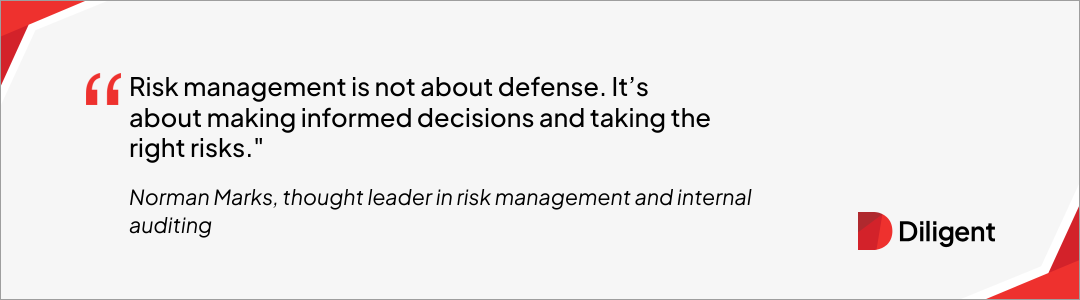
As Norman Marks, thought leader in risk management, points out, "Risk management is not about defense. It’s about making informed decisions and taking the right risks."
City council members need to be aware of the common types of risks that local governments typically face. Key risks facing local governments today are:
Forward thinking municipalities use data-backed risk profiling and gap analyses to protect their operations, employees and the communities they serve. Informed data helps municipalities measure and manage their tolerance for risk.
By being careful with other parts of the municipal government's budget, that can also free up financial resources to invest in risk management and other projects for the benefit of the community.
Local governments must focus on their municipality's needs, which is often influenced by citizen opinion. Many other things also influence a local government's goals and those can change quickly. Every election also brings changes. One local government council may favor making improvements in law enforcement, road improvements or public safety, and the next administration may shift the focus to building new parks and making improvements in the schools.
A risk manager can be instrumental in ensuring that a municipality tackles change and risk with confidence. By managing risks as well as possible, municipalities will spend less on litigation, losses and claims.
While local governments are structured differently than for-profit companies and nonprofits, they also benefit from having a risk manager because they're frequently required to comply with regulations, meet citizen requirements and, at the same time, do more with less. Another important difference for local government risk management is that many of the services that companies provide are mandated by the government. Local governments have to provide law enforcement, emergency services, public safety services, health services, human services and jails. Many of the services that municipalities offer pose substantial exposure to risk. They have no choice but to assume certain risks for the good of the public. Finances can also make it challenging for municipalities to manage risk. The most common sources of revenue are generated through taxation, licensing fees and bonds. Budget constraints, along with public scrutiny, require checks and balances.
Transparency in local government about how the budget is managed and how risks are being addressed helps to increase the public's trust level. This, in turn, helps governments gain the necessary support and satisfaction from their communities.
Don't wait for a security breach to happen. Strengthen your local government security posture today to continue confidently serving your community.

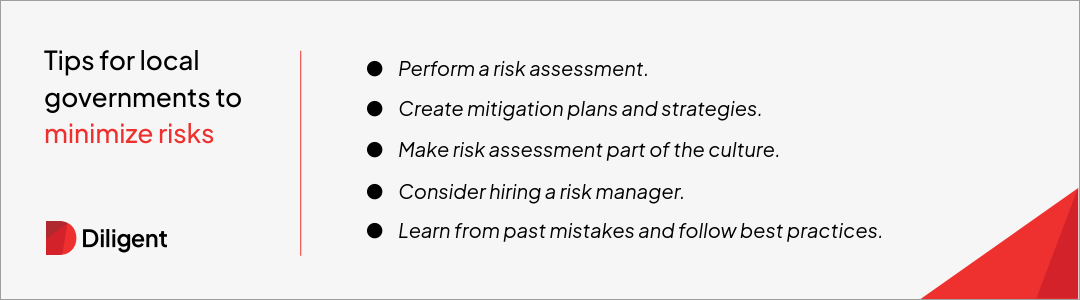
It’s not possible to foresee and plan for every emergency or problem that local governments face. However, they can prepare for likely risks, such as the ones we listed above. Here are some ideas to get started.
When it comes to managing risks, local government boards face tough decisions every day. Whether it’s managing cyber risk, ensuring compliance, preparing for audits or staying ahead of new regulations, the risks are constant.
Diligent Community is the next-generation governance solution designed to enhance effectiveness and efficiency for public boards and leadership teams. Tailored to cater to the unique needs of diverse public organizations, Diligent Community empowers streamlined decision-making, ensuring transparent and effective governance.
Diligent Community is your essential tool for driving impactful governance, fostering better communication and achieving shared success.
That’s where Diligent Community steps in. It streamlines meeting preparation, making sure agendas and board packets are centralized, secure, accessible and easy to update. Board information and documents are kept securely stored with granular permissions to give access only to those who should view them.
Diligent Community helps improve public trust by giving the council a way to show the community they are making thoughtful, responsible decisions. The solution makes it easy to share meeting minutes, voting records and financial updates online. With everything out in the open, residents can feel reassured, and council members feel empowered to keep making smart choices.
Diligent Community is built for local governments, with features designed to tackle your biggest challenges. It helps you stay organized, prepared and transparent — all while saving time to focus on more strategic tasks.
As a Diligent Community customer on the Diligent One Platform, your team will also be able to access Diligent AI Risk Essentials, helping you simplify risk oversight with AI-powered benchmarking to identify relevant risks quickly, and support you along the way with guided onboarding and educational resources, including access to Diligent Institute’s new ERM Certification.
Managing risks doesn’t have to mean sleepless nights and endless spreadsheets. Diligent Community makes the hard stuff manageable, so your team can focus on managing risks and leading your community with confidence.