
In this article

Risk management in higher education has moved from a back-office compliance exercise to a strategic priority for college and university leaders. Enrollment cliffs, ransomware attacks, evolving federal regulations and intense public scrutiny now converge in ways that can threaten an institution’s financial stability, reputation and core academic mission. Yet many institutions still manage these risks in departmental silos, with student affairs, IT, finance and research each operating independently.
The result is fragmented visibility. A cybersecurity breach in one unit can cascade into regulatory penalties, reputational harm and enrollment declines without ever appearing on a board risk dashboard.
According to the Q4 Business Risk Index by Diligent Institute and Corporate Board Member, business risk stands at 7.9 out of 10, a 16% increase since the start of 2025, with only 4% of organizations reporting fully integrated governance, risk and compliance systems. Higher education institutions face the same integration challenge, often compounded by decentralized governance structures and limited risk management budgets.
This guide helps institutional leaders and board members move from fragmented risk handling to enterprise-wide risk management. It covers what risk management means in a higher education context, the specific risk categories facing colleges and universities, how boards should structure risk oversight and practical steps for building and maturing an ERM program, including how technology can accelerate the process.
This comprehensive guide explains:
Risk management in higher education is the process by which colleges and universities identify, assess, prioritize and mitigate threats that could prevent them from fulfilling their academic mission and strategic objectives. It applies to every area of institutional operations, from enrollment and financial sustainability to cybersecurity, research integrity and campus safety.
Unlike corporate risk management, which typically focuses on shareholder value and regulatory compliance, higher education risk management must balance academic freedom, shared governance traditions and a public service mission alongside financial and operational realities. A state university managing a $2 billion endowment faces different risk dynamics than a private liberal arts college operating on tuition revenue alone. But both share the need for a structured, institution-wide approach.
A critical distinction separates risk management from risk oversight. Risk management is the administration’s responsibility: The president, provost, chief financial officer and operational leaders identify risks, implement controls and execute mitigation strategies day to day. Risk oversight belongs to the board of trustees (or board of regents). The board sets risk appetite, ensures accountability and confirms that management’s risk processes are effective.
When these roles blur, institutions end up with either boards micromanaging operational risk decisions or, more commonly, boards that rubber-stamp management reports without meaningful engagement. Effective higher education risk management requires both functions operating clearly within their lanes while maintaining strong communication between them.
Enterprise risk management (ERM) provides the framework that connects risk management and risk oversight into a unified system. Rather than treating each risk category in isolation, ERM creates a shared language, consistent assessment criteria and centralized reporting that gives boards and administrators a complete picture of institutional risk exposure.
According to Diligent Institute’s Risk and Opportunity Outlook, 47% of directors want more frequent and structured risk discussions at the full-board level, while 32% seek clearer connections between risk oversight and strategy. For higher education, this translates to a need for risk conversations that go beyond compliance checklists and address enrollment strategy, financial sustainability and institutional reputation.
Higher education institutions face a distinct risk landscape shaped by their academic missions, public accountability and complex stakeholder relationships. The following categories represent the primary risk domains institutional leaders should address.
Enrollment is the lifeblood of most institutions. Demographic shifts, increased competition from online programs and alternative credentials, and changing student expectations create persistent enrollment pressure. Many institutions project enrollment declines over the next decade as the number of traditional college-age students shrinks in key regions.
Retention compounds the challenge. Every student who leaves before graduation represents lost tuition revenue and reduced completion rates. These metrics affect accreditation, rankings and public perception. Institutions that lack data-driven enrollment forecasting and early-warning retention systems often discover these risks too late to respond effectively.
A CBO survey reveals that about 42% of chief business officers rate their institution's financial health as less than good. Deloitte trends adds that "the post-election landscape in America brings a layer of complexity to questions of financial sustainability," noting impacts to cash flow and uncertainty surrounding federal funding.
Tuition dependency, endowment volatility, state funding reductions and rising operational costs create ongoing financial pressure. Many institutions operate with narrow margins, leaving little buffer for unexpected disruptions.
Deferred maintenance represents a hidden financial risk across the sector. Aging infrastructure requires capital investment that competes directly with academic program funding and technology upgrades. Institutions that delay these investments face compounding costs and potential safety liabilities.
Universities are high-value targets for cybercriminals. They hold vast repositories of personal data, research intellectual property and financial records, all spread across distributed IT environments with varying security standards. Ransomware attacks targeting higher education have increased sharply, and the costs extend far beyond ransom payments into remediation, legal exposure and reputational harm.
According to What Directors Think 2026 by Diligent Institute, Korn Ferry and Corporate Board Member, 63% of directors have incorporated cyber events and data breaches into their crisis preparedness exercises, the highest of any scenario tested. Yet despite this, only 28% view cybersecurity as a top organizational risk and just 12% say strengthening cybersecurity defenses is a priority for 2026. For universities, where FERPA, HIPAA and research data protections intersect, this disconnect between awareness and action carries particular weight.
Higher education operates under a dense web of regulations: Title IX, the Clery Act, FERPA, HIPAA, NCAA rules, accreditation requirements and state-specific mandates. Compliance fatigue is real. When regulatory obligations change frequently and span multiple departments, gaps emerge, often in areas where institutions face the greatest penalties.
Federal enforcement actions, Department of Education audits and accreditation reviews can each trigger cascading consequences that affect funding, enrollment and public trust. Institutions need compliance systems that track obligations centrally rather than relying on individual departments to self-monitor.
Social media has compressed the timeline from incident to reputational crisis. Campus safety events, academic integrity scandals, political controversies and Title IX investigations can all generate national attention within hours. Alumni and donor relationships, which often take decades to build, can be damaged by a single poorly managed incident.
“There’s often an inclination to avoid bad news, with a hope that problems will be resolved before they escalate to the board level,” says Pav Gill, CEO of Confide. “But boards should proactively request access to whistleblowing reports. It’s essential to see firsthand how secure, robust and effective the current mechanisms are.”
Effective reputational risk management requires crisis communication plans, established escalation protocols and a culture of transparency that encourages early reporting rather than concealment.
Staffing shortages, deferred maintenance, technology failures and emergency preparedness gaps all fall under operational risk. The post-pandemic higher education workforce has shifted significantly, with many institutions struggling to fill critical administrative and technical roles. When key positions go unfilled, risk management processes often suffer first because they depend on consistent, cross-functional coordination.
Higher education institutions face a unique set of fraud risks, including
These risks can have severe consequences, such as financial losses, damage to reputation, legal consequences and regulatory noncompliance.
For example, a recent case at the University of Central Florida (UCF) saw thieves stealing $107,625 through a sophisticated hacking scheme. The fraud involved hacking into a vendor’s computers, tricking officials into transmitting money to a different bank account and swamping the school’s email system to prevent warnings from being noticed. This incident highlights the importance of robust internal controls and continuous monitoring.
Learn more about today's most pressing regulatory risks by downloading the latest edition of our global compliance outlook.

Board oversight of risk is distinct from risk management itself, but the two must work in concert. Boards that treat risk as a standing agenda item, not a quarterly compliance update, create the governance pressure that drives institutional preparedness.
Effective board risk oversight in higher education includes several key practices. First, boards should establish clear risk appetite statements that define the level and types of risk the institution is willing to accept in pursuit of its strategic goals. A board that has not articulated its risk appetite cannot meaningfully evaluate whether the administration is taking appropriate risks.
Second, risk committee structures matter. Some boards assign risk oversight to the audit committee, while others create dedicated risk committees. The right structure depends on institutional size and complexity, but what matters most is that someone owns the conversation. Risk oversight that is everybody’s responsibility often becomes nobody’s priority.
Third, boards should ensure they receive risk reporting that connects to strategic planning. A risk register presented in isolation from the institution’s strategic plan is useful for compliance but insufficient for governance. The most effective boards link each major risk to a strategic objective, making risk discussions inherently forward-looking rather than backward-looking.
“The winners will be the companies that recognize that risk and opportunities need to be standing discussion topics on the board agenda,” says Ana Dutra, an experienced public and private company director. For higher education boards, this means treating risk as a strategic discipline rather than a compliance obligation.
Moving from ad hoc risk handling to a structured ERM program requires deliberate effort, but institutions that make the investment gain visibility, coordination and resilience that siloed approaches cannot match. Here is a practical sequence for building or maturing a higher education ERM program.
1. Secure executive sponsorship and governance structure: ERM programs need a champion at the cabinet or C-suite level, typically the chief financial officer, chief risk officer or provost. Without executive sponsorship, risk management becomes a paper exercise that operational leaders ignore. Establish a risk committee or working group with representatives from academic affairs, student services, finance, IT, research and facilities.
2. Conduct institution-wide risk identification: Gather input from every major unit through workshops, surveys and interviews. The goal is to build a comprehensive risk inventory that captures risks from the classroom to the boardroom. Include both traditional risks (financial, compliance) and emerging ones (AI governance, climate resilience, geopolitical disruptions to international enrollment).
3. Build a risk taxonomy and scoring framework: Create a consistent language for categorizing and rating risks. A common approach uses likelihood and impact scales (such as 1–5 ratings) to produce heat maps that visualize the risk landscape. Keep it practical. As Maurice L. Crescenzi Jr., Industry Practice Leader at Moody’s, advises: “High, medium, low are good enough. Keep your presentations to the board simple. Demonstrate practicality throughout the entire process.”
4. Set risk appetite and tolerance thresholds: Work with the board to define how much risk the institution is willing to accept across each category. A research university with significant grant funding may have a higher tolerance for research-related risk but low tolerance for compliance failures. These thresholds guide operational decision-making and resource allocation.
5. Assign risk ownership across departments: Every identified risk needs a named owner responsible for monitoring and mitigation. Ownership should sit with the person closest to the risk. For example, the chief information security officer for cybersecurity risk, or the enrollment management vice president for enrollment risk. Centralized risk ownership in a single office creates bottlenecks and reduces accountability.
6. Implement monitoring, reporting and review cadences: Establish quarterly risk reviews at the operational level and semi-annual (or more frequent) reporting to the board. Use dashboards that track risk indicators over time, showing trends rather than point-in-time snapshots. Integrate risk reporting into existing governance calendars so it becomes part of institutional rhythm rather than an add-on.
7. Embed risk management into strategic planning: The most mature ERM programs connect risk assessment directly to strategic planning cycles. When the institution evaluates a new academic program, a capital project or a technology investment, the risk implications should be part of the decision framework, not an afterthought.
ERM frameworks and reporting tools are only as effective as the culture that surrounds them. Institutions where risk management lives exclusively in a compliance office will always struggle with incomplete risk visibility. Building a risk-aware culture means embedding risk thinking into everyday decision-making at every level, from academic department chairs to student services directors to the board.
This starts with communication. Risk language should be accessible, not buried in technical jargon. When risk teams present findings to non-specialist audiences, visual tools like heat maps and trend dashboards make the information actionable.
Training is equally important. Faculty and staff who understand how to identify and escalate risks contribute to a broader early-warning system that no centralized team can replicate. Institutions should incorporate risk awareness into onboarding, annual training and departmental planning sessions. The goal is not to turn everyone into a risk manager but to ensure that potential threats are recognized and reported before they escalate.
“The root of the problem here is often cultural, and it’s no secret that lack of compliance can kill a business,” says Anastassia Lauterbach, PhD. “It’s up to the executive leadership team to find the right balance for how much compliance is involved in day-to-day operations.” For higher education, this balance is particularly delicate: overly rigid compliance frameworks can stifle academic freedom, while insufficient oversight creates regulatory exposure.
The challenges documented throughout this guide, from fragmented risk visibility and siloed departments to manual monitoring processes and the need for integrated board-level reporting, are exactly the problems that AI-powered governance platforms address. For institutions looking to move from reactive risk handling to proactive risk management, integrated technology provides the foundation.
Diligent provides industry-leading solutions to help institutions strengthen oversight, mitigate risks and ensure compliance with evolving regulations.
With a centralized platform for enterprise risk, audit, and compliance management, institutions can use our solutions to make data-driven decisions, improve financial integrity, and safeguard their reputation.
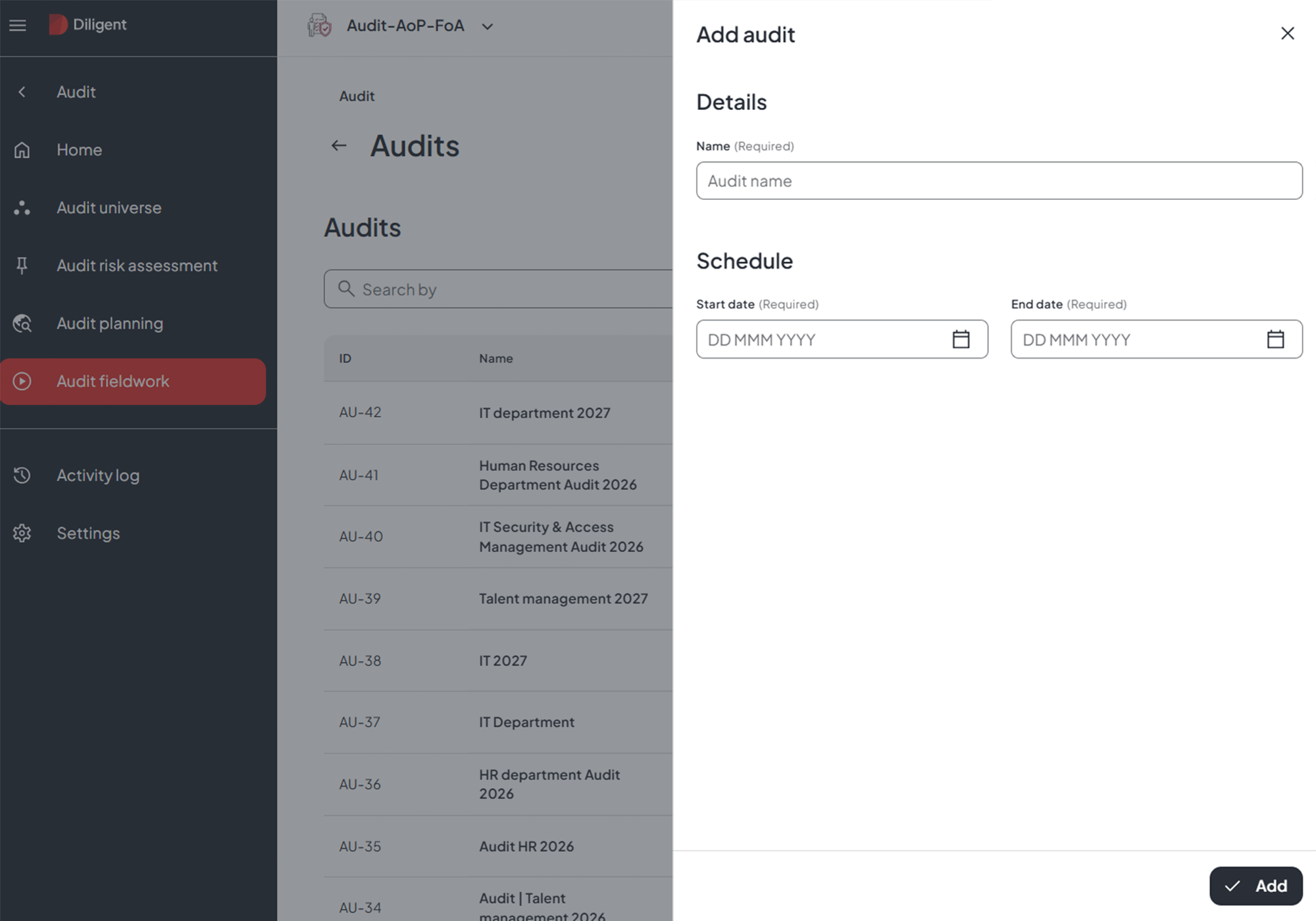
Risk-based audit planning helps lean audit teams focus resources on the highest-impact areas, while automated workpapers and continuous monitoring reduce the manual burden that consumes audit capacity. Daikin Australia’s small audit team achieved a 50% reduction in resource time on repetitive audits after implementing the platform, freeing capacity for strategic advisory work.
Together, these solutions create an integrated risk and audit infrastructure that scales with institutional complexity rather than requiring proportional headcount increases. For higher education leaders managing expanding risk obligations with constrained resources, this integration is essential.
Being on the Diligent One Platform also unlocks Diligent Institute's governance education library, including its ERM Certification. For higher education institutions, this means trustees, audit committee members and risk owners can build foundational risk fluency through structured coursework while the platform handles day-to-day identification, monitoring and reporting. Technology and education together close the maturity gap faster than either does alone.
Talk to us today about how you can integrate your risk and audit management to improve oversight, reduce fraud exposure and operate with greater confidence.
The most significant risks facing higher education institutions include enrollment and retention declines, cybersecurity threats, financial sustainability pressures, regulatory compliance obligations (Title IX, FERPA, HIPAA, Clery Act), reputational risk amplified by social media and fraud or financial misconduct. The relative priority of each risk varies by institution, but cybersecurity and enrollment are consistently cited as top concerns across the sector.
Boards should establish a clear risk appetite statement, assign risk oversight to a specific committee (audit or dedicated risk committee), ensure risk reporting connects to strategic planning and receive regular updates that include trend data rather than point-in-time snapshots. The board’s role is oversight and accountability, not operational risk management; that responsibility belongs to administration.
Internal audit provides independent assurance on control effectiveness, while ERM facilitates risk ownership across the institution. Collaboration includes aligning audit plans with ERM risk assessments, sharing real-time risk data through integrated dashboards, conducting continuous risk assessments and jointly monitoring for fraud and compliance gaps. This partnership ensures both functions complement rather than duplicate each other.
Effective risk technology for higher education includes real-time dashboards for centralized risk visibility, data analytics for continuous monitoring and fraud detection, automated workflows for compliance tracking and AI-powered risk identification that benchmarks institutional risks against peer institutions. Integrated platforms that connect ERM, audit and compliance data provide the most comprehensive risk oversight.
Ready to strengthen your institution’s risk management? Schedule a demo to see how Diligent’s integrated risk and audit platform supports higher education governance.

A better approach to managing IT risk for public sector
Effectively managing IT risk is fundamental to achieving mission goals. But for too many public sector organizations, that’s far easier said than done. In this eBook, we explore how IT risk manifests in your organization and share best practices for assigning ownership of risk assessment, mitigation, and monitoring among the multiple functions involved.