
At Elevate 2026, AI leader Noelle Russell reframed the question every board is asking. Most AI pilots fail because the governance work happens too late, if at all. Here is what boards moving from enthusiasm to execution are doing differently.
Ninety-five percent of AI pilots fail to deliver value for the companies running them. That statistic anchored Noelle Russell’s keynote at Diligent Elevate 2026, and it landed hard with a room of governance, risk, and compliance leaders. The failure rate itself surprised nobody. Russell’s framing of the cause was the new part: the 5% of pilots that succeed share one variable, and that variable is governance.
Many board conversations about AI still treat it as a technology question, with the decisions framed around tools, vendors, and use cases. Russell, founder of the AI Leadership Institute and a 20-year veteran of AI leadership roles at AWS, Microsoft, IBM, and Amazon Alexa, made a sharper case at Elevate. For boards, AI has crossed from a technology question into a fiduciary one.
“95% of AI pilots fail to ever deliver value for the companies they’re in.”
— Noelle Russell, founder and chief AI officer, AI Leadership Institute
The gap between AI enthusiasm and execution is wider than many leadership teams realize. Russell described it plainly. Tools get built by people who are still waiting for feedback. Use cases get scoped without the people who will use them in the room. Governance frameworks get written after deployment instead of before it.
The consequences are familiar. Pilots that look promising in demo never make it into production. Production systems that should be scaling get stalled by avoidable trust issues. Risk teams discover problems months after they could have been designed out. Boards end up making AI decisions from dashboards that tell them very little about what is actually happening inside their organizations.
Russell’s argument: this is an accountability problem, not a technology one. And accountability is a board-level concern.
One of the most useful reframes in Russell’s keynote was about what AI adoption now means for executives and directors. The traditional model of AI assumes a single large system doing a single large job. The reality emerging in most organizations looks different: multiple AI systems running in parallel, some built in-house, some provided by partners like Diligent, some from Microsoft or other vendors, all working together, all requiring human orchestration.
That changes the governance question. Boards are no longer being asked to approve a single AI use case; they are being asked to oversee a fleet of systems. Systems that will talk to each other, make decisions on behalf of the organization, and reflect the values of whoever built them, or whoever forgot to. Russell put it more directly: when you build an AI system with your words, you realize you are ultimately responsible for those systems.
That is a fiduciary statement, not a technical one. It is also one of the reasons boards that treat AI as a governance question are moving faster than boards still treating it as an IT project.
See how AI Board Member gives boards the oversight infrastructure they need.
"Trust is built through human collaboration, not through a cool tool."
— Noelle Russell, Founder and Chief AI Officer, AI Leadership Institute
The most quoted moment from Russell’s Elevate keynote was also the most self-deprecating. She told a story about a nursing facility she worked with early in her career. Her team had built a shift change report system that took a 45-minute manual process down to six minutes. By every conventional measure, a clear win.
Then a nurse stood up and corrected her. The 45-minute shift change was not a problem to be optimized. It was the only part of the day where the nursing team got to sit together, talk about the patients they cared about, and process what had happened on their watch. Russell had taken that away. Efficiently, but completely.
The point applies directly to board-level AI oversight. The AI systems that succeed share a different pattern. They get built with feedback from the people who will use them. They get refined against lived experience. They get governed by humans who understand the workflow being touched.
That is why responsible AI adoption is a strategic question rather than a compliance one. The organizations getting it right are the ones whose governance frameworks are designed to surface the nurse in the room: the person who can tell you what the system is about to break before you ship it.
Russell also shared a story about working with Goodwill. The organization hires people with cognitive disabilities and wanted to use AI to support their work. Her team built an iPad app that helps employees with Down syndrome more accurately identify donated items as they come in. One product decision, designed with the users in mind rather than for them.
The outcome was a $2.3 million revenue lift. Goodwill had never seen anything like it.
The lesson from Goodwill is not really about disability inclusion, though that matters too. It is about what happens when an organization pairs AI adoption with the governance discipline to ask the right questions: who is this for, what problem is it actually solving, what does success look like for the people on the ground. Those are governance questions. They are the ones boards should be asking before the technology choice is made, not after.
Boards that want to move from AI enthusiasm to AI execution need three things in place. The first is clear accountability: a documented answer to who owns each AI system, who reviews it, who is empowered to stop it, and how often. The second is connected data, because AI cannot help a board whose information lives in five different systems. The third is a way for the board itself to engage with the organization’s AI estate at the right altitude. Not technical detail. Not vague abstraction. The kind of insight that supports fiduciary decision-making.
That is the gap Diligent built AI Board Member to close. It is a secure digital boardroom expert that synthesizes board materials, surfaces decisions, stress-tests risk scenarios, and gives directors a way to engage with the organization’s AI-relevant information without leaving the governance environment. Think of it as an expert that has effectively read every word of your board papers and can answer any question about what is in them.
AI Board Member sits within the broader agentic GRC workforce Diligent introduced at Elevate, alongside AI Risk Essentials and the rest of the AI-driven GRC platform. The thread running through all of it is the one Russell pulled on in her keynote: responsible AI is a governance question, and governance is a board-level decision.
Russell closed her keynote with a line that has been quoted everywhere since. We are the last generation that will teach machines to listen. Whether that is literally true is beside the point. The substantive claim underneath is that we are the last generation with full discretion over how AI is integrated into the institutions we lead, and the first generation that will be measured on whether we got it right.
The 95% of AI pilots that fail will keep failing for as long as governance is treated as the work that happens after the technology choice is made. The 5% that succeed will be the ones whose boards understood early that AI adoption without governance accountability is how organizations fail, and built the infrastructure to make sure their organization was not one of them.
That work starts now. And it starts in the boardroom.
Ready to see what AI governance infrastructure looks like in practice?
Noelle Russell is the founder and chief AI officer of the AI Leadership Institute, an award-winning technologist and AI ethicist with over 20 years in AI leadership roles at AWS, Microsoft, IBM, and Amazon Alexa. She delivered the headline guest keynote at Diligent Elevate 2026 in Atlanta on Thursday, April 23, 2026.
From AI talk to real impact: How today’s leaders do more without adding headcount
Unlock the potential of AI in governance, risk, and compliance with our comprehensive guide. Learn how to streamline workflows, enhance reporting efficiency, and build a robust AI action plan while maintaining control and accountability. Download now to elevate your organization's AI oversight and drive measurable impact.
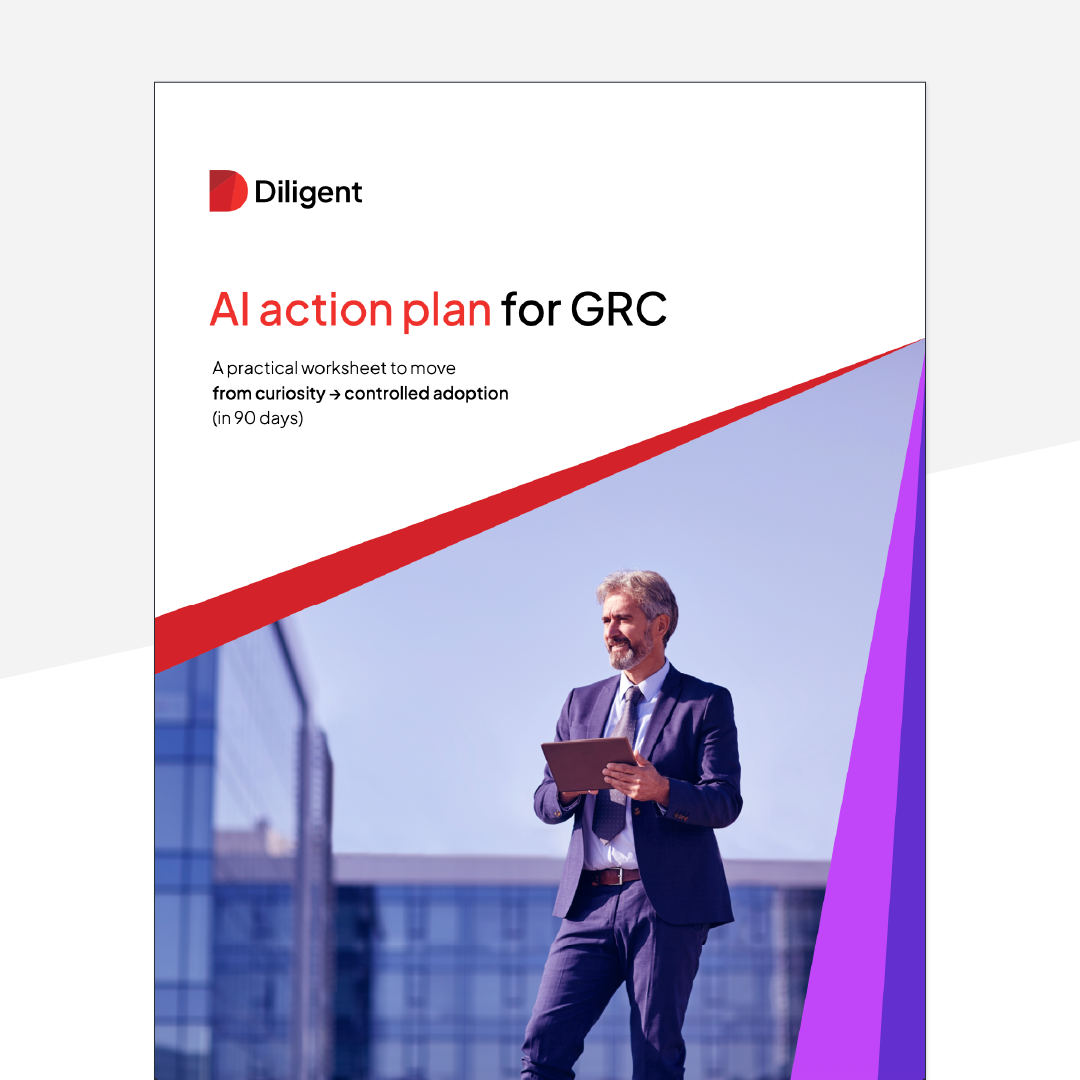
AI action plan worksheet for GRC leaders
Unlock the potential of AI in governance, risk, and compliance with this practical 90-day action plan worksheet designed for GRC leaders. This guide helps you assess AI maturity, prioritize use cases, and establish essential guardrails, ensuring a structured and accountable approach to AI implementation in your organization. Download now to transform AI discussions into a clear, actionable strategy.
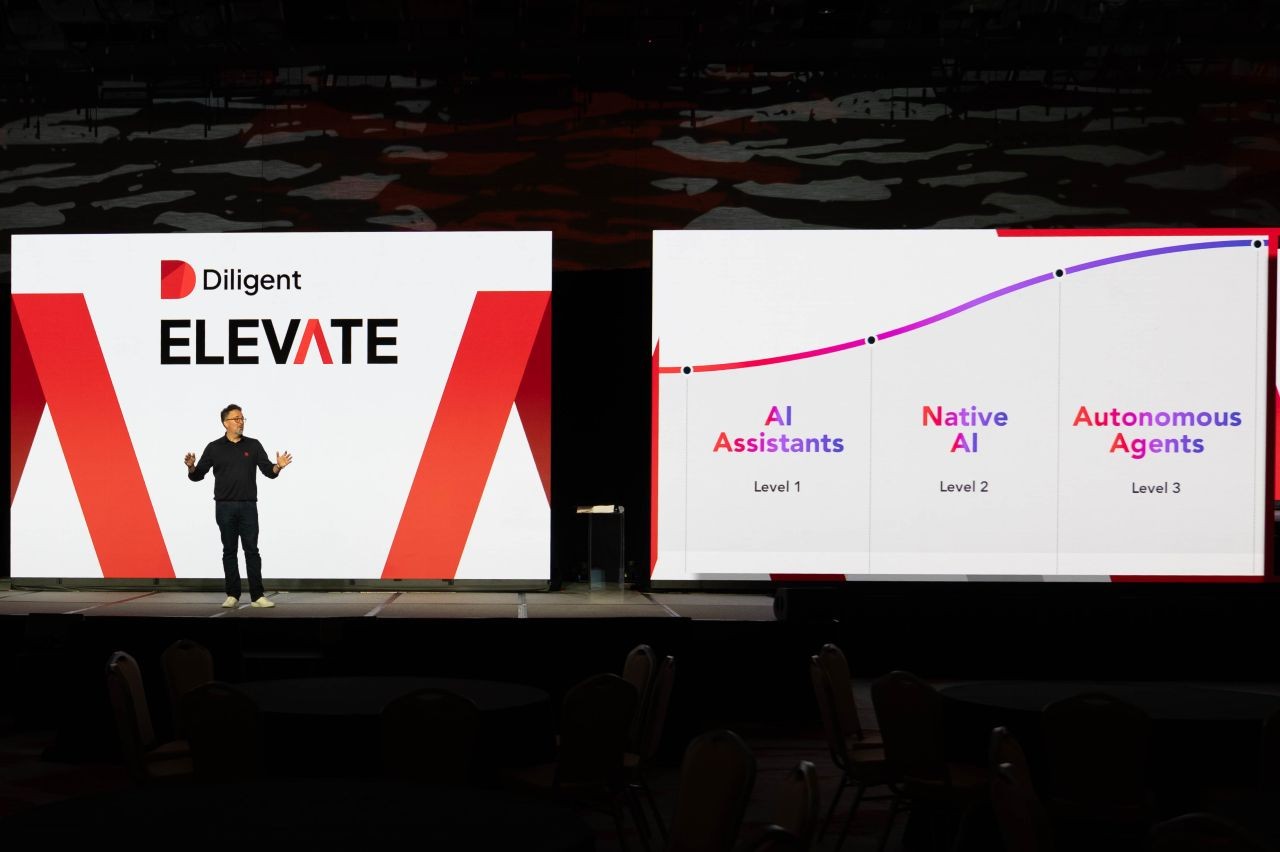
Elevate 2026 highlights: From responsible AI to authentic leadership

Elevate 2026 brought together over 600 governance and compliance professionals in Atlanta to explore the transformative impact of AI on risk management and leadership. Key discussions highlighted innovative solutions like AI Board Member, emphasizing the importance of connected data and responsible AI implementation for effective governance in a rapidly changing landscape.