
In this article

Most founders discover their governance isn't investor-ready at the worst possible moment, when a VC's legal team asks for board minutes mid-diligence and the response is a scramble through email threads and shared drives. That's not a position any growth-stage leader wants to be in during a process that will define the company's next chapter.
The gap between "we're running things informally" and "we're ready for institutional capital" is smaller than most people assume, but it has to be closed before investors start asking questions, not after.
This playbook is the operational guide to getting ahead of that moment. It covers the board structure, documentation, financial reporting and operating rhythm that institutional investors expect to see, so your Series A conversations focus on your growth story, not on whether you can produce a clean cap table.
This guide covers everything you need to know about preparing governance infrastructure for Series A preparation:
Governance isn't paperwork. It's a signal investors read immediately and it tells them whether you can manage institutional capital or whether you'll be a liability risk.
When a VC partner reviews your company, they're not just evaluating your product and revenue trajectory. They're assessing whether the business is built on a foundation that holds up under scrutiny. That means clean entity records, a functional board structure, organized financials and documentation that doesn't fall apart the moment outside counsel starts pulling threads. Companies that arrive at diligence without this infrastructure lose credibility, slow down term sheet timelines and occasionally lose deals entirely.
According to Carta Series A data, the median time between seed and Series A rounds reached 616 days, with approximately two months of that extension attributed specifically to heightened investor expectations for governance readiness and operational readiness.
Starting governance formalization six months before active fundraising, rather than reacting to it during conversations, can prevent that timeline extension entirely. The companies that close faster and on better terms aren't the ones with the most impressive pitch decks. They're the ones whose back office matches their front office.
The following steps are organized into four phases: board structure, documentation, financial reporting and operating rhythm. Together, they move your company from informal operations to institutional-grade governance.
Step 1: Formalize the board of directors: If your company still operates with an informal advisory group rather than a voting board, fix that before investor conversations begin. Transition to a formal board of directors with clear fiduciary mandates — duty of care and duty of loyalty — documented in your corporate records. Investors need to see that governance decisions are made by a legally constituted body rather than by casual founder consensus.
Step 2: Define board composition: The standard Series A board consists of five members: two founder or executive seats, two seats allocated to lead investors and one independent director mutually agreed upon by both sides. This structure balances founder control, investor oversight, and independent judgment. You don't need to fill all seats before fundraising, but you should understand the framework and have a plan for the independent seat.
Step 3: Establish committee basics: Even a lean board needs documented decision-making authority and approval thresholds. At a minimum, establish a compensation committee to oversee executive pay and equity incentive plans. Define which decisions require full board approval: equity issuances, debt above a specified threshold, and related-party transactions. Document those thresholds in your bylaws.
Explore how growth-stage companies prepare for funding rounds and exits with professional governance infrastructure.

Step 4: Centralize governing documents: Your articles of incorporation, bylaws, cap table, stock option plan, prior board minutes, written consents and stockholder agreements need to live in one secure location, not scattered across email, Google Drive and a lawyer's filing cabinet.
Create a single source of truth that anyone on your team can access when an investor asks for a specific document. Standardize file naming with dates (YYYY-MM-DD format) and document types to prevent anything from getting lost.
Step 5: Audit your minute and consent history: This is where most growing companies discover problems. Go through every board meeting and corporate action since incorporation and confirm that each one has a corresponding set of minutes or a written consent with actual signatures.
Missing or informal approvals — especially around equity grants, officer appointments and major contracts — are among the most common diligence red flags. Create a chronological index, match each equity issuance to its board approval, and fill gaps with ratification resolutions before investors find them.
Step 6: Build a clean data room: Investors will request one, and having it organized and ready signals operational maturity before a single document gets reviewed. Use a standard folder hierarchy: corporate formation documents, equity and compensation records, material contracts, intellectual property documentation, employment agreements, financials and compliance records. Professional naming conventions, a master index document and logical organization tell investors that the company is run with discipline.
One practical benchmark: keep board-ready work and deal-ready work in the same controlled environment, so board materials, approvals and diligence content don't splinter into separate tools as soon as diligence starts.
Step 7: Align financial reporting to board expectations: Monthly or quarterly board packages should tell a coherent story, not just dump numbers. Lead with an executive summary highlighting accomplishments, priorities, risks and specific asks from the board. Follow with income statements showing actual versus budget versus prior period, a cash flow snapshot, forward-looking forecasts and a strategic KPI dashboard with trend lines. Context matters more than raw numbers. Founders need to explain why metrics moved, not just that they moved.
Step 8: Integrate financial data into board materials: The manual export-paste-format cycle — pulling numbers from your accounting system, dropping them into slides and reformatting everything — is a liability waiting to surface during a live round. Every manual step introduces risk of error, and errors in board financials undermine investor confidence in your operational controls. Connect your accounting system to your reporting workflow so financial data flows directly into board materials without manual intervention.
According to The Transaction Readiness Report by Diligent Institute and its research partners (2025), only 4% of organizations have fully integrated GRC and financial systems. For a Series A team, the practical implication is straightforward: if governance approvals, compliance artifacts and finance outputs live in separate silos, expect reconciliation work and credibility questions during diligence.
Step 9: Create a board book template: Consistency and professionalism in board materials signal that the company is run with discipline. Build a standardized template with a clean cover page, table of contents, consistent headers and one topic per section.
Use action-oriented titles — "ARR grew to $X" rather than "Revenue Update" — and keep detailed backup data in appendices so the main package stays focused. Structured, consistent formats enable board members to quickly identify changes and patterns across reporting periods.
Step 10: Establish a cadence for board meetings: Quarterly meetings are the baseline minimum, with documented agendas distributed five to seven days in advance, formal minutes drafted within 72 hours and action items tracked with clear ownership and deadlines.
Target two-and-a-half to three hours per meeting, with time allocated across financial review, operational metrics, a strategic deep dive and governance items. As you approach active fundraising — roughly three months out — shift to monthly meetings to demonstrate governance maturity and give the board a direct role in supporting fundraising strategy.
Step 11: Run a pre-funding compliance check: Before investors start pulling records, identify every gap in entity filings, IP assignments, regulatory standing and corporate documentation. Verify good standing certificates in every operating state, confirm all IP assignments are signed for every founder, employee and contractor who touched the product, check that 83(b) elections were properly filed, ensure your 409A valuation is current and confirm all business licenses are up to date. Proactively disclosing issues with proposed solutions builds investor trust. Issues discovered during diligence erode it.
Step 12: Make transaction readiness continuous, not reactive: Governance that requires rebuilding for every funding round slows you down. The companies that close rounds efficiently treat readiness as a continuous operating standard: board materials stay current, documentation stays organized and compliance stays monitored. This isn't about perfection. It's about maintaining a baseline of institutional quality so that when the next round comes, you're updating a data room, not building one from scratch.
VC legal teams follow a predictable playbook when they open your data room. Knowing what they're looking for and having it ready is the difference between a two-week diligence process and a two-month one.
Here's what institutional investors and their counsel verify:
According to Kairos failure research, 73% of startups initially fail due diligence, with over half of those failures directly linked to governance deficiencies, including disorganized cap tables, financial misreporting and legal problems. A pre-funding self-audit using the playbook above puts you in the minority of those who pass cleanly.
Discover how AI transforms board preparation and decision-making for growing companies.

The playbook above surfaces three persistent operational bottlenecks: manual board book preparation, disorganized transaction documentation and undiscovered compliance gaps. Diligent's platform addresses each one directly.
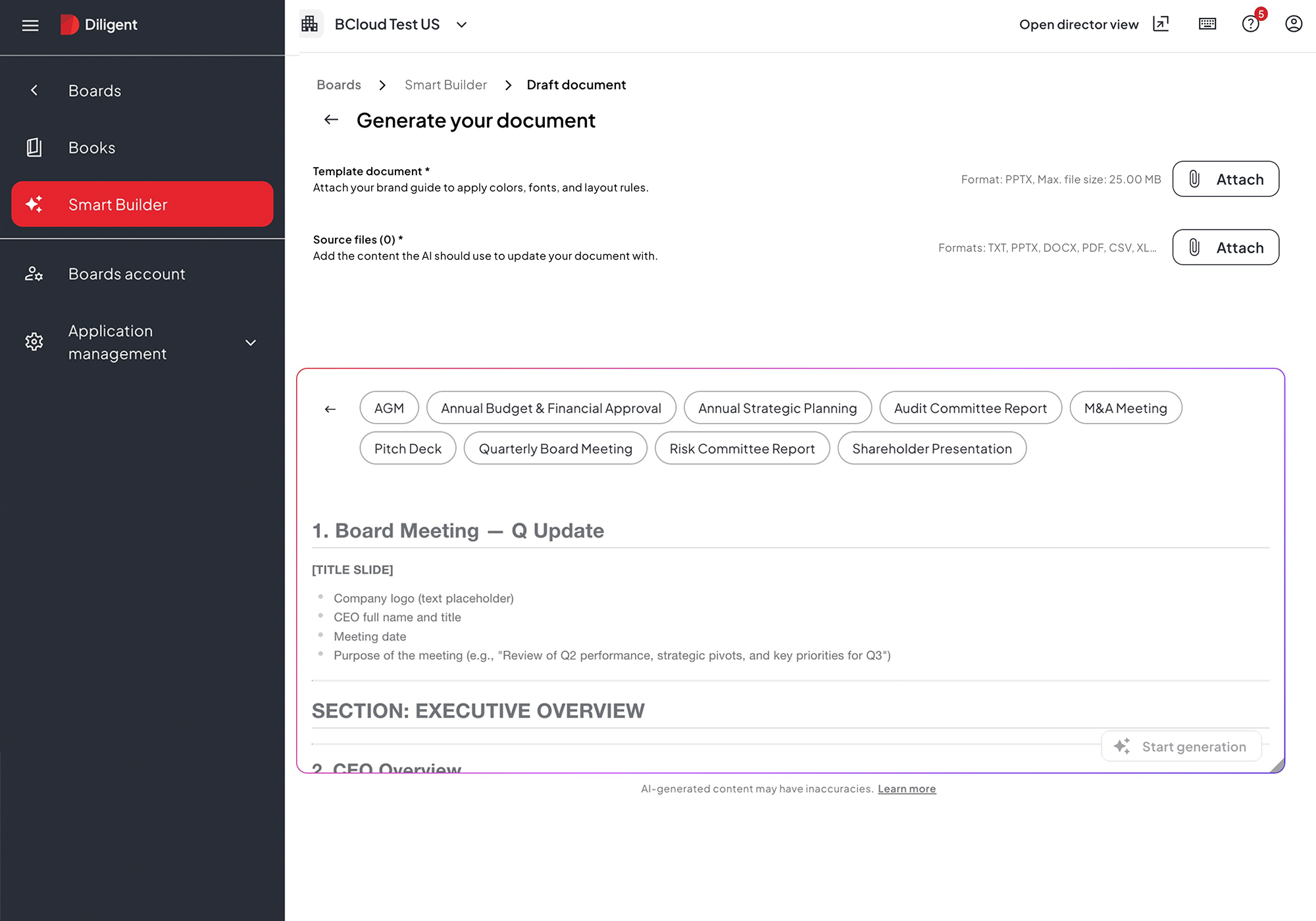
Together, these capabilities help governance infrastructure scale through funding rounds rather than requiring a rebuild every time capital needs change.
The companies that close Series A faster and on better terms share one trait: they treat governance readiness as a continuous operating standard, not a pre-close fire drill. Every step in this playbook compounds over time.
The board structure you formalize now carries through to Series B. The data room you organize today becomes the foundation for every future transaction. The financial reporting rhythm you establish this quarter builds the track record investors want to see next year.
Ready to see how Diligent helps growing companies stay transaction-ready from Series A through exit? Schedule a demo.
Start at least six months before you plan to actively fundraise. Use the first two months to formalize board structure and meeting cadence, spend months three and four on compliance verification and cap table reconciliation and reserve the final two months for IP audits and data room assembly.
Incomplete or missing IP assignment agreements surface in approximately 60% of diligence processes, making it the single most frequent problem investor counsel encounters. Confirm that every founder, employee and contractor who contributed to the product has signed a comprehensive invention assignment agreement.
Legally sufficient minutes need to include meeting logistics (date, attendees, quorum confirmation), all resolutions with exact wording and vote tallies, high-level summaries of major topics discussed, management responses to board questions, and specific action items with ownership and deadlines. Keep them concise — typically one to three pages — and draft within 72 hours of the meeting.
Work with legal counsel to prepare ratification resolutions that formally retroactively approve historical actions. Create a chronological index of every corporate action since incorporation, match each to its documentation and flag gaps. Proactively disclosing issues with proposed solutions builds investor trust. Issues discovered during diligence erode it.
Build governance infrastructure that grows with your company? Book a demo to see Diligent in action.