

In this article

GRC reporting is how organizations turn governance, risk and compliance activity into board-ready intelligence. A good GRC report synthesizes risks, controls and obligations into a single view for boards, executives and regulators.
According to the 2026 GC Risk Index by Diligent Institute, organizations are operating in an “always on” risk environment, with risk rated at 7 out of 10 and only 21% of legal leaders very confident their board receives the right mix of risk information.
For chief risk, compliance and audit executives, the work has moved beyond producing more documents on a faster cadence. The harder task is building the data infrastructure, governance roles and technology that let a clean signal reach the board before problems escalate. This guide covers how:
The OCEG GRC Capability Model defines GRC as an organization's ability to achieve objectives reliably (governance), address uncertainty (risk management), and act with integrity (compliance). Each component requires measurement, monitoring and evidence to demonstrate performance and progress to stakeholders.
GRC is now being treated as a growth driver rather than just a risk mitigation tool and regulatory requirement. Your performance in all aspects of GRC will play a growing role in your organization's attractiveness as an investment, employer, and supplier.
As regulatory requirements accelerate, GRC reporting has transformed from periodic compliance exercises to continuous business intelligence.
The EU AI Act, CSRD and ISSB standards push AI governance and ESG metrics into board-level disclosure. Per the What Directors Think 2026 report by Corporate Board Member and Diligent Institute, 41% of directors call AI and technology regulation the most underestimated compliance oversight area today.
Organizations now face both voluntary reporting frameworks, like the Task Force on Climate-Related Financial Disclosures (TCFD) and mandatory requirements such as gender pay gap disclosures. This dual obligation requires governance infrastructure that supports comprehensive data collection, analysis and stakeholder communication without creating an unsustainable administrative burden.
Not every GRC report serves the same reader. Matching content to audience is the first discipline that separates effective programs from administrative ones.
Synthesized, decision-oriented board reports for audit, risk or full-board discussion. They cover the top five to ten exposures, the status of significant compliance matters, cybersecurity posture and control effectiveness trends. Visual summaries work best, with evidence available on request.
For C-suite consumption, these track key risk indicators (KRIs) against appetite, emerging risk themes, control testing outcomes and resilience metrics. Cadence is typically monthly for senior leadership and weekly or daily for operational risk owners.
Filings, disclosures and audit deliverables for regulators, auditors, rating agencies, customers and supply chain partners. Specific disclosure schema govern these, making data lineage and audit trails essential. When all three streams draw from the same data and control library, executives avoid reporting different numbers to different audiences.
A strong GRC report answers four questions: What are our most material risks? Are our controls working? Where are the exposures? And what are we doing about them? Board-level versions compress each answer into a paragraph; operational and regulatory versions expand the same structure with supporting evidence. Practically, those questions translate into:
The discipline is keeping these components consistent across every report the organization produces. When a board pack, a quarterly management report and a regulator filing are built on the same backbone, the numbers reconcile and directors stop asking why two reports tell different stories.
The board retains strategic responsibility for GRC reporting and plays the central role in oversight. However, effective implementation requires coordinated involvement across multiple organizational functions with clear accountability and information flow.
Directors set strategic direction for GRC programs, approve risk appetite, and ensure adequate resources for effective governance. They review comprehensive reports that synthesize data from across the organization into actionable insights about risk exposure and compliance status.
“Tell the board what they need to know, not what you know,” says David Platt, Chief Strategic Development Officer and Member, Executive Leadership Team at Moody's. This principle recognizes that boards need synthesized intelligence, not raw data dumps.
In practice, that means leading with the decisions directors need to weigh in on, tiering detail so the top page is an executive summary with evidence on demand, and pre-aligning with the CRO, CCO and CAE before the meeting so board time goes to judgment rather than catch-up.
The C-suite translates board direction into operational reality. Chief risk officers, chief compliance officers and chief audit executives own specific GRC domains while collaborating to provide integrated reporting that reflects how risks and compliance obligations interact across business processes.
These functions generate the detailed analysis that supports board reporting. They collect data, assess risks, monitor controls and identify compliance gaps. Collaboration between these historically siloed teams has become essential for comprehensive GRC reporting.
Process owners and department heads provide the operational data that underpins GRC reporting. Their engagement determines the data quality and the organization's ability to respond effectively when reporting and identifying issues that require remediation.
“What are the risks you want the board to be focused on?” asks Derek Vadala, Chief Risk Officer at Bitsight Technologies. “The board really wants to understand, 'What should they be worried about? What are you doing about it? How are we doing in that program?' It's hard to get to that conversation, which is key to establishing trust, because we start with bringing a lot of data and not showing what to focus on.”
Unlock seamless GRC reporting and drive informed decisions. Download our comprehensive guide to holistic GRC!

Boards cannot delegate their fundamental accountability for governance, risk management, and compliance. While they appropriately delegate operational execution, directors maintain oversight responsibility that requires them to understand GRC performance and hold management accountable for results.
Effective boards approach GRC reporting as a strategic tool. They establish clear expectations about what information they need, in what format, and at what frequency. This clarity prevents the common problem of overwhelming directors with excessive data while omitting critical insights.
Leading boards typically expect:
Boards model the importance of GRC by dedicating adequate meeting time to governance discussions, asking probing questions about risk management effectiveness, and ensuring management has appropriate resources for GRC programs. When boards treat GRC as an afterthought, the entire organization follows their lead.
The most effective boards establish dedicated risk committees or expand audit committee charters to encompass comprehensive GRC oversight. This structural change signals that GRC deserves focused attention from directors with relevant expertise.
Organizations struggle with GRC reporting for predictable reasons that stem from complexity, resource constraints, and inadequate technology infrastructure. Understanding these challenges helps identify targeted solutions rather than implementing generic improvements that fail to address root causes.
GRC reporting requires data from multiple systems, departments, and geographic locations. Manual data collection creates opportunities for errors, omissions, and inconsistencies that undermine report credibility and decision-making quality.
Organizations often discover data quality problems only when preparing board reports or responding to regulatory inquiries. By that point, remediation requires expensive manual verification and delays reporting timelines.
Business processes span multiple departments, systems, and entities in ways that traditional organizational structures don't naturally capture. This fragmentation makes it challenging to comprehend how risks propagate throughout the organization or how compliance gaps in one area can create exposure elsewhere.
Risk, audit, compliance and legal functions often operate independently with separate tools, processes, and reporting lines. This fragmentation creates redundant effort, inconsistent terminology, and gaps where responsibilities overlap or fall between organizational boundaries.
“By far our most commonly used feature is search. Having that single source of truth can help break down silos,” says Curtis Duncan, Senior Manager, Customer Success at Diligent.
Organizations with siloed GRC functions spend excessive time reconciling different risk assessments, resolving conflicting compliance interpretations, and explaining why various reports present different pictures of organizational performance.
GRC now spans cybersecurity, financial controls, supply chain risk and ESG commitments. Covering all of them requires coordination and expertise most teams do not have in one place. Organizations struggle to prioritize among competing demands while ensuring adequate coverage of all material risks.
Without comprehensive approaches, organizations take tactical responses to individual requirements rather than building an integrated governance infrastructure. They implement point solutions for specific regulations, creating technical debt and integration challenges.
Organizations that excel at GRC reporting implement specific practices that deliver actionable intelligence while managing complexity and resource constraints effectively. These practices reflect lessons from companies that successfully transformed governance capabilities.
Define what success looks like for GRC reporting before implementing processes and technology. Identify the specific decisions that reporting should inform, the stakeholders who need information, and the frequency required for different report types. Clear objectives prevent the common trap of collecting excessive data that is never used for decision-making. They enable prioritization when resource constraints require choices about where to focus improvement efforts.
Data quality determines reporting credibility. Organizations need consistent definitions, standardized collection processes, and validation procedures that ensure accuracy and completeness across all data sources.
Practically, build four things into your data model: a shared risk taxonomy so an operational risk is categorized the same way across finance, IT and compliance; single-source data capture where each metric has one system of record; named data stewards for every risk, control and obligation; and version control so directors can see when a figure changed and why.
Breaking down silos between risk, audit, compliance, and business functions requires intentional effort. Create cross-functional working groups, establish shared objectives, and implement collaborative tools that make cooperation the path of least resistance.
“Everyone has a role to play in risk management. You don't have to be a risk professional; you can be on a school board, in a nonprofit, or in a large corporation. It's something everyone should be doing, looking at the risks and the future,” says Amanda Carty, Managing Director, Strategic Market Solutions at Diligent.Implement continuous improvement processes
GRC reporting should evolve based on feedback from boards, management, and regulatory developments. Regularly solicit input about report usefulness, clarity, and timeliness. Track leading indicators like report preparation time, data accuracy and decision-making impact.
Use this intelligence to refine reporting content, adjust frequency and improve processes that create bottlenecks or quality problems.
Manual processes cannot deliver the real-time visibility, comprehensive coverage, and analytical depth that contemporary GRC reporting requires. Organizations require platforms that automate routine tasks, integrate data from multiple sources and provide insights that enhance human judgment.
The right technology eliminates administrative burden while improving reporting quality and decision-making effectiveness. It creates capacity for strategic work by handling repetitive data collection and validation tasks.
Knowing what good looks like is only half the battle. Most teams need a sequenced path to get there, and the sequencing matters more than the specific tools. The steps below build on each other: skipping the early work on scope and data ownership makes the later platform work twice as expensive. Expect the full rollout to span two or three quarters for most enterprises.
Steps one through three are the ones teams are tempted to skip. They are also the ones that decide whether the platform work in steps four and five pays off. Treat the roadmap as cumulative rather than parallel.
Transform how your organization approaches governance, risk and compliance with automated monitoring, real-time dashboards and intelligent reporting.

Manual GRC reporting cannot scale to meet current requirements. The volume of data, complexity of regulations, and speed of business change exceed human capacity for comprehensive oversight without technological support. Organizations need unified platforms that integrate governance, risk, compliance and audit management rather than disconnected point solutions.
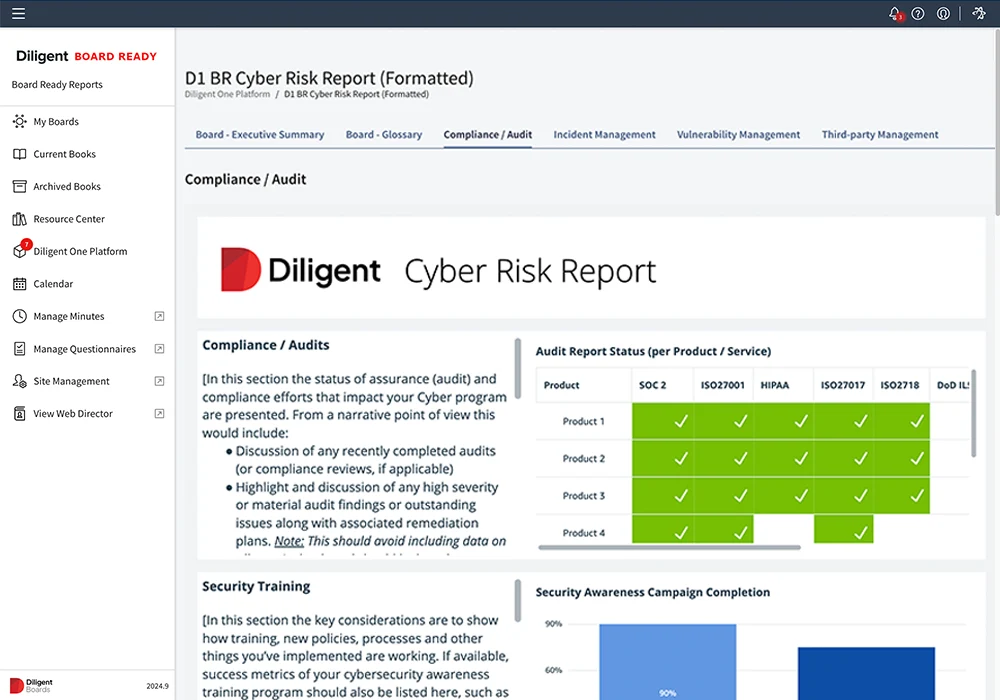
Diligent structures this as a single platform with four connected layers: a unified governance spine, AI-powered board preparation, continuous controls monitoring and enterprise risk intelligence. Each layer feeds the others, so an issue surfaced in audit is visible in risk and appears in the next board pack.
The Diligent One Platform connects board collaboration, enterprise risk, compliance, audit and entity management into a single reporting spine. Executives work from one data model with role-based access that respects privilege and confidentiality, and real-time dashboards give directors visibility across locations, entities and business units.
Smart Builder synthesizes source materials, committee updates and prior decisions into structured board packs, cutting the manual compilation that typically consumes days of a corporate secretary's time. Smart Risk Scanner reviews board documents for risky language and disclosure exposures before publication. SmartPrep generates discussion questions with source citations, so directors arrive with the questions they need to ask, not a reading assignment.
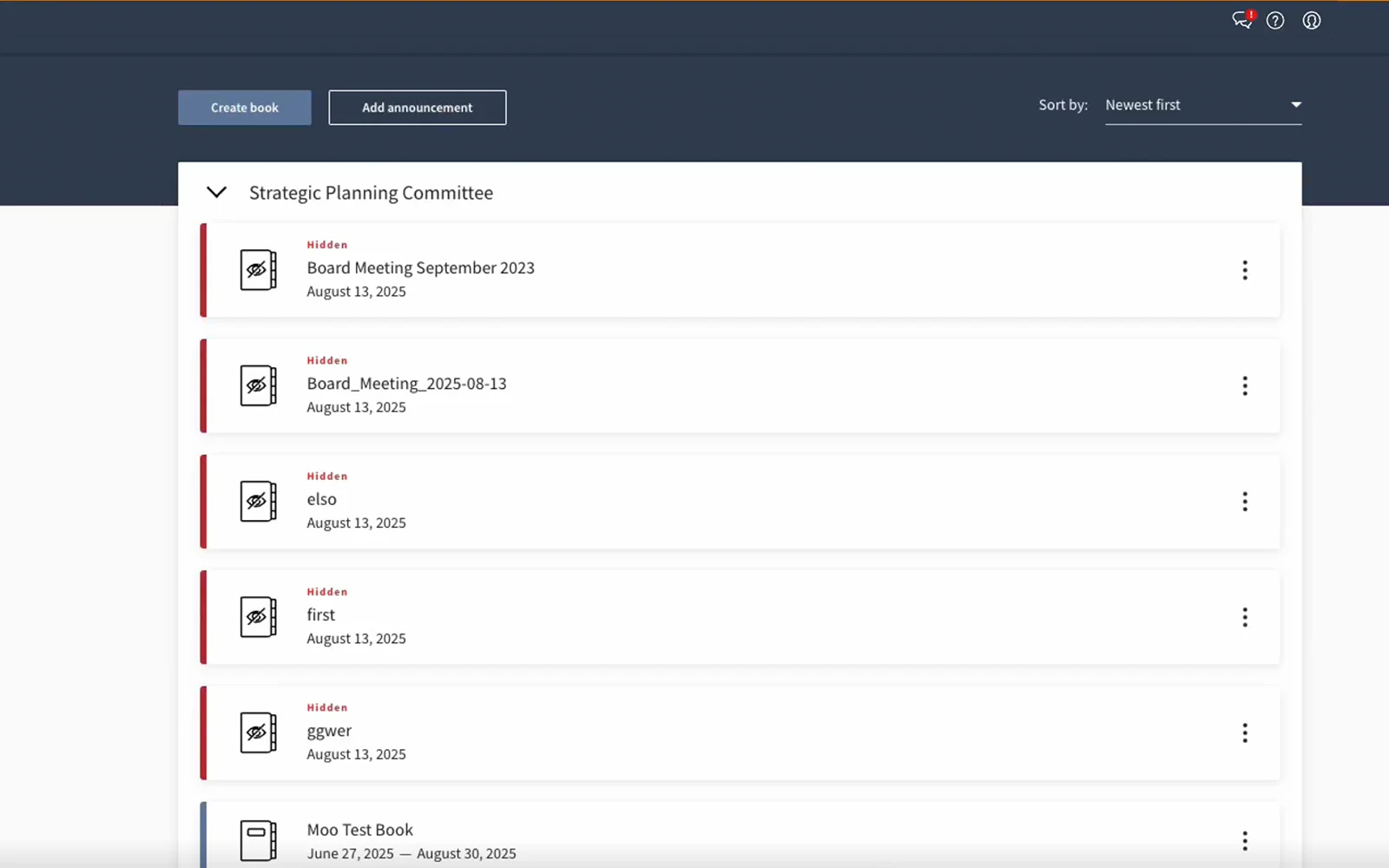
For audit and compliance leaders, Diligent Internal Audit and AI-enabled controls analytics replace periodic, sample-based testing with near-continuous oversight. The platform analyzes large volumes of transactional data, flagging anomalies and control deviations earlier than sampling allows. That shortens the gap between an issue arising and leadership seeing it, which determines whether GRC reporting produces timely decisions.
Diligent ERM delivers the risk data engine behind board-level reporting: risk registers, scenario modeling, KRI tracking and Moody's benchmarking, with FedRAMP authorization for regulated-industry use. Lean teams launching a first program can start with AI Risk Essentials and migrate as they scale, while Diligent Entities closes the entity-level blind spots that undermine multi-jurisdictional reporting.
Telepass, the European mobility operator, consolidated its risk and audit work onto Diligent One Platform. “The number of days that I allocate to action follow-up is reduced by 50%,” says Michele Variale, Chief Audit Executive at Telepass. “Now we have comprehensive, single, unique reporting available to the board.”
Most CROs and CCOs know what good GRC reporting looks like. The difficulty is executing it consistently across fragmented systems and a regulatory environment that keeps adding scope. The frameworks in this guide are the playbook: synthesized board reports, shared taxonomies, named data owners and continuous monitoring in place of quarterly snapshots.
The gap most teams live with is the distance between that playbook and a Monday where regulators have new questions, the audit committee meets Thursday and testing data still sits in spreadsheets. Technology becomes the operational backbone that lets a small team deliver reporting at enterprise scale.
See how Diligent connects board, risk, audit and compliance reporting into one source of truth with a personalized demo.
Public companies face accelerated SEC disclosure requirements, including material cybersecurity incidents within four business days, alongside ESG, EU AI Act and sector-specific obligations like DORA for financial services. These requirements have shifted reporting from quarterly cycles to near real-time compliance, which is why leading programs build their data infrastructure around continuous monitoring rather than periodic snapshots.
Risk and audit reports are inputs; GRC reporting is the synthesis. A standalone risk report tracks exposures against appetite, an internal audit report documents control testing results, and a compliance report covers regulatory obligations. GRC reporting pulls all three streams together so directors see how risks, controls and obligations interact, rather than reading three reports that share no common taxonomy.
Cadence varies by audience. Operational and KRI dashboards typically run weekly or monthly so risk owners can act on movement before issues escalate. Executive committee reports run monthly to quarterly, and full-board GRC packs run quarterly within the broader board reporting cycle, with interim updates for material events. The discipline is matching cadence to decision frequency rather than producing reports on a calendar nobody uses.
Conflicting findings usually signal a taxonomy or data ownership problem rather than a substantive disagreement. The fix is procedural: name a single executive, typically the CRO or CCO, to adjudicate before reports reach the board; agree on shared definitions for severity and likelihood; and maintain a common risk register so the same exposure gets one rating across functions. Reconciled findings build director trust in the reporting itself; visible contradictions erode it.
Common failures include underestimating data quality requirements, implementing technology without addressing organizational silos, and choosing solutions that don't scale with business growth. Successful implementations require thorough change management alongside technology deployment.
Track process and outcome indicators together. Process measures include report preparation time, data quality error rates and cycle time from control failure to board visibility. Outcome measures include fewer regulatory findings, fewer surprise escalations and director satisfaction with board materials. Review these quarterly with the audit or risk committee.
Strengthen your GRC reporting with enterprise-grade AI. Schedule a demo to see how Diligent connects governance, risk and compliance on a single reporting backbone for the board.




