
In this article

According to Diligent Institute's What Directors Think 2025 research, 42% of directors now cite strategy as their most challenging responsibility to oversee, dethroning cybersecurity for the first time in years. This shift reveals a fundamental truth about the board of directors' responsibilities: while the specific challenges evolve, the board's core role remains constant — providing strategic oversight and acting in the best interest of shareholders and stakeholders.
The board of directors exists to oversee corporate objectives and operations and act in the best interest of its shareholders or stakeholders. From the bottom to the top, every role within a corporate board comes with distinct definitions, responsibilities and duties. Each role of a board of directors was designed to manage a specific purpose within the organization.
Board roles and responsibilities need to be clearly defined. The organization’s bylaws typically outline duties for the board, board chair, corporate secretary, general counsel and committees. The duties and responsibilities for C-suite-level executives and senior-level managers are usually outlined within the written job description for the role.
Clear communication and expectations for transparency are prime factors in effective collaboration within every role of a corporation, often made easier with board management software. In a perfect corporate world, there shouldn’t be any gaps or overlaps. However, achieving a seamless balance of executive and board roles and responsibilities is easier said than done. Here, we will explain the most essential corporate roles, including:
The board of directors is a group of individuals elected to represent shareholders and oversee an organization’s activities and strategic direction. They:
Whether serving a nonprofit or a private or public company, the board is vital to governance, leadership and long-term success. The more effective the board, the stronger the organization will be.
The core purpose of a board of directors centers on strategic oversight, fiduciary duty and organizational accountability. While specific duties vary by organization type and industry, most boards share these fundamental responsibilities:
These responsibilities require boards to maintain independence from management while building the trust necessary for effective governance. As Chandu Vemuri, Executive Assistant at Sun Prairie Schools, notes: “You can't really have an engaged board if you're not creating a relationship of trust with the board members. It is teamwork, and building that relationship is crucial”
There are different board types depending on the organization’s structure, goals and stage of development. Here are the five most common types of boards:
Different board types require different governance approaches. Discover which model best fits your organization's stage, structure and strategic priorities.

The most crucial governance structure for any board is creating an environment of trust and respect. The means to that end often look alike: building high-functioning teams, putting each director through a set process of recruiting, orientation and evaluation.
Assembling an effective board requires a keen eye for its composition. All boards need a demographically diverse mix of members with complementary skill sets and knowledge bases. As they anticipate turnover, they should always consider how recruits would add to that mix. If the only attorney on the board is leaving, finding another attorney is better than adding a fifth or sixth accountant.
Board size, independence, and more also influence its structure and performance.
Corporate boards should be large enough to bring diverse perspectives and competencies into the boardroom to encourage robust debates and discussions. The generally accepted size for corporate boards is between eight and 12 board directors. Boards must be large enough to form sufficient committees to do the work.
In addition, board committees need to have enough members to do their work. Boards may be tempted to increase the size of their boards because they desire gender diversity and to fill all the needs for specialist issues, such as cybersecurity. However, boards must find the balance between adequate expertise and not expanding the board unnecessarily.
Boards that are too large lose effectiveness. Regardless of the board’s size, all board directors are expected to contribute to the success of the board.
Best practices for board composition expect that the minimum requirement for boards is that the majority of directors be non-executive, independent directors. In addition to being independent of board business, 'independence' also refers to independent thinking, so the board is not likely to cave to groupthink.
It’s best if board directors don’t have any personal or commercial conflicts of interest. If any conflicts arise, board directors should declare them and refrain from voting on related matters.
Independent board members shouldn’t be recent former members of the company. There should be enough time between employment and directorship for the board director to be objective. To be truly independent, board directors shouldn’t have any financial relationships with the company or its counterparts. Independent directors shouldn’t have interlocking directorships. Also, it’s vital that board members not be selected to fill a void in executive weakness.
Best practices for board terms require a dynamic approach. A director’s longevity on a board isn’t necessarily a sign of director success. Having fixed, staggered terms encourages board refreshment and renewal, yielding a revolving set of fresh and innovative ideas and thought processes.
Term limits for board directors offer greater accountability and transparency. Shareholders have also expressed their desire for companies to set board terms.
The search for board director candidates who offer diversity is another area that has forced boards to widen their pool of candidates. Diversity on corporate boards is a healthy sign because it ultimately leads to better overall decision-making. It’s also vital that board directors are diverse in their thinking patterns because it brings various experiences, perspectives, interests, and thought patterns.
In some areas, politics and regulations are becoming players in demanding greater board diversity. Boards should also look for diversity within their board chairs and CEOs.
Board directors serving on multiple boards is another board composition issue where trends are changing. In past years, no one considered how many boards a director served on. With new demands and pressures, best practices suggest that board directors should serve on no more than five boards.
Certain times of the year get hectic for board directors’ schedules, such as around the time of the annual general meetings. In the interests of time, it may not be possible for directors to serve on more than three or four boards, especially if they have to fly across various continents. Beyond these reasons, if even one company were to go into some sort of crisis, a board director would have to give that board priority with his attention. Board directors must be available for at least 20-30 days a year and be committed to attending six to 10 board meetings throughout the year.
A skills matrix is a strategic tool used to assess and align the expertise, experience and diversity of a board of directors with the organization’s goals. It helps identify gaps, guide recruitment and ensure the board has the capabilities needed to govern effectively.
Boards tailor their matrix to their unique needs, but typical categories include governance and leadership, financial expertise, legal and compliance and more. Most matrices are laid out to visualize the skills of each board member. Here’s an example you can customize to include the areas of expertise you seek:
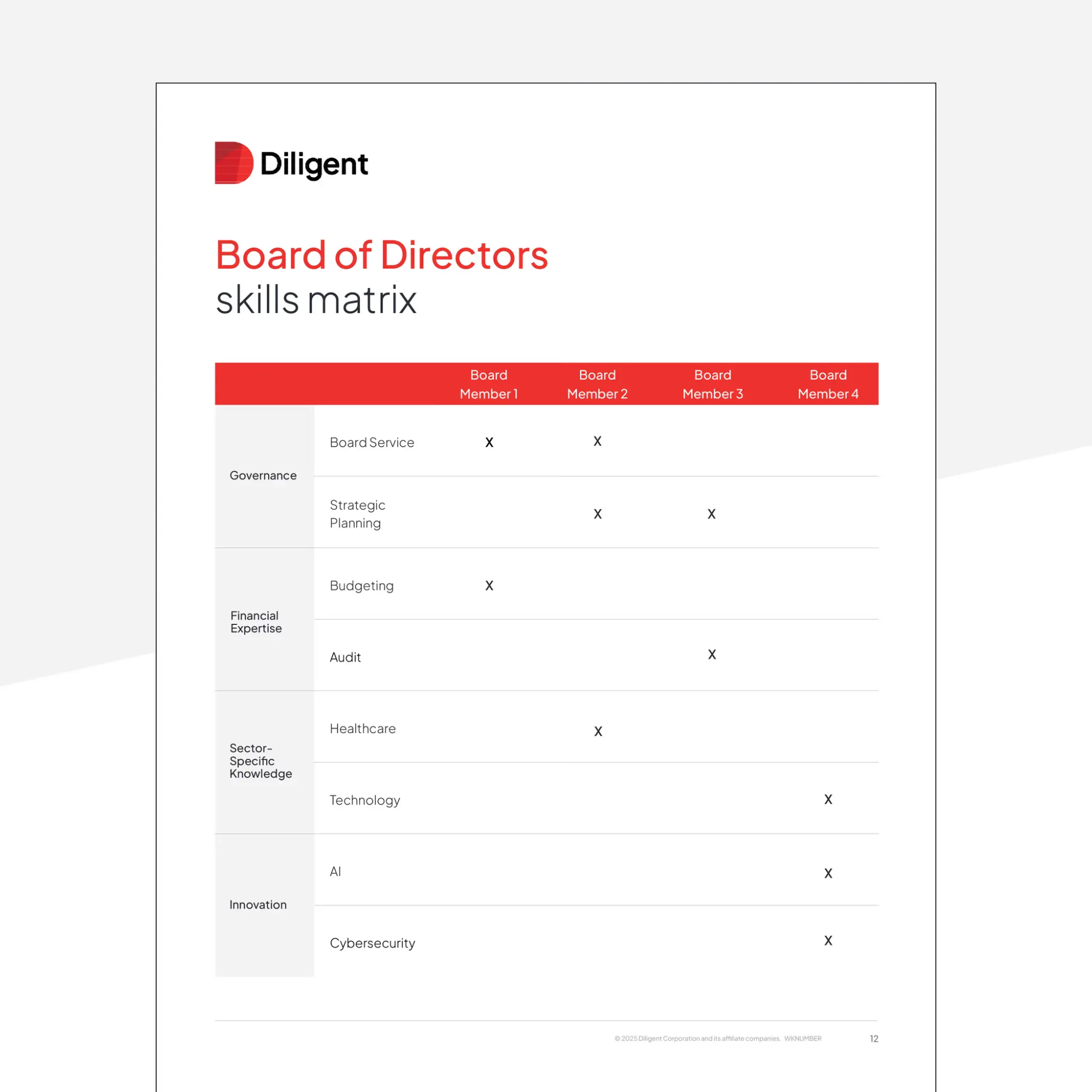
Each board member is assessed across the matrix to show which competencies are well-covered and which are underrepresented. This fuels proactive succession planning and equips the nominating and governance committee with the insights to recruit effectively once a board vacancy arises.
Effective succession planning ensures your board maintains the right mix of skills and expertise as directors rotate.

The board of directors operates under formal and informal rules that uphold accountability, transparency and effective governance. These rules help guide board conduct, decision-making and responsibilities:
Board members must act in the organization’s and its shareholders’ best interest. In doing so, they’re bound by three core legal responsibilities:
Beyond its fiduciary duty, there are rules for board members covering their day-to-day duties. These rules depend on the organization’s bylaws, but they will typically outline:
Boards may also be subject to additional policies for conflicts of interest, board attendance and ethics.
Board members must also meet specific meeting expectations, including:
One of the abiding rules for board members is to avoid conflicts that interfere with their fiduciary duty. Conflict of interest and privacy policies vary, but boards are typically expected to:
Today’s boards of directors are expected to be strategic and effective in driving value. The main role of a board of directors in corporate governance is to perform the duties of strategic planning and oversight. While these terms are used often, it’s important not to diminish these duties, as they are the backbone of successful business planning. Their roles and responsibilities also include:
These mission-critical responsibilities mean that the board of directors is much more than iconic figureheads. When choosing board members to fill vacant seats, boards typically look for specific qualities. Board members expect their fellow board directors to be willing to ask tough and probing questions to vet all sides of an issue.
When corporations hit bumps in the road, all fingers typically point back to the board of directors. Board directors must be willing to act quickly and responsibly when they need to take action to comply with fiduciary responsibilities or to uphold good governance standards. A crisis may occur at any time. Board members’ responsibilities state that they need to stand ready to thwart potential crises and to manage developing crises so they don’t adversely affect the corporation.
Board chairs interact with nearly everyone in the organization, so the board must select a person to fill the role who can meet the strong expectations that come with it. The board chair’s responsibilities are to:
Beyond the day-to-day, board chairs are also responsible for relationship building. Most people who serve as board chairs are keenly aware that they need to develop a trusted relationship with the CEO and other executives.
In a mutually beneficial relationship, the board chair acts as a mentor and advisor to the CEO. Working collaboratively, the board chair helps the CEO to translate the board’s strategic plans into action.
The board chair needs to be willing to ask the CEO the hard, probing questions that come from the board and work in tandem with the CEO during times of crisis. Both parties work best together when the board chair maintains an open-door policy to keep the lines of communication open. Board chairs must also be mindful that their roles are vastly different from the CEO’s responsibilities. The board chair mustn’t usurp the CEO’s authority or overstep the CEO’s role.
The board chair also needs to develop a strong relationship with the board directors and facilitate board meetings so that the board can do its own work. This duty includes encouraging all board members to be actively engaged. The board chair also typically participates in annual board member orientation, onboarding and development.
One of the busiest and most well-known people in an organization is the corporate secretary. Corporation laws in every state require corporations to appoint a corporate secretary. When discussing the role of the corporate secretary, it’s prudent to mention that it is evolving along with recent corporate developments. Corporate secretaries are now considered senior positions with major governance and board management responsibilities.
The duties and responsibilities of today’s corporate secretaries often call for the role to be filled by a senior board member with certain areas of expertise. Corporate secretaries’ responsibilities include:
Discover Diligent's checklist for corporate secretaries to improve board effectiveness and mitigate all challenges ahead

A lawyer must fill the role of the general counsel. The board views the general counsel position as responsible for:
The top-level executives have come to be known as the C-suite. This often includes the chief executive officer (CEO), chief information officer (CIO), chief security officer (CSO), chief operations officer (COO), chief risk officer (CRO) and chief financial officer (CFO).
Each person in the C-suite is responsible for:
Having a good relationship with the board ensures that C-suite executives will stand a good chance of gaining the board's support for their many roles and responsibilities. The board chair plays an instrumental role in keeping the lines of communication between C-suite executives and board members open and collaborative.
While the board’s diversity and independence continually challenge C-suite-level executives, they do well to welcome probing questions as opportunities for responsible planning. C-suite executives need to recognize the experience of board members and remain open-minded and flexible in their responses to the board.
It’s wise for C-suite executives to acknowledge that one of the board’s responsibilities is succession planning. C-suite executives sometimes encourage senior managers to make presentations to the board to give the board opportunities to continue developing an internal management talent pipeline.
While C-suite executives have the final authority and responsibility, senior managers also play an essential role in implementing the board’s strategic plans. Senior managers:
One high-profile example of a board’s oversight and strategic decision-making is The Walt Disney Company. In 2022, under then-CEO Bob Chapek, Disney’s board acted decisively, facing declining stock prices, creative misfires, and investor concerns.
They reviewed the company’s strategic position, leadership challenges and opportunities and then voted to replace Chapek by bringing back Bob Iger; he had served as CEO for 15 years and was widely credited with Disney’s successful acquisitions of Pixar, Marvel, Lucasfilm and 21st Century Fox.
This move demonstrated the core responsibilities of the board of directors:
Board meetings are integral to the board’s overall effectiveness. The more collaborative the board is before meetings, the more engaged they can be during the meeting — and the better they can navigate risks and opportunities after the meeting ends.
But effective meetings don’t just happen. Here’s what each board member is expected to do at each stage to support them:
From preparation to follow-up, structured meeting processes ensure better engagement, more productive discussions and stronger governance outcomes.

The world is increasingly complex and interconnected, and the business landscape continues to evolve rapidly. But, according to Diligent’s What Directors Think survey, board members feel more in control and optimistic. Of board members surveyed, 76% say pursuing growth is their top priority, and 78% say growth strategies would be the most pressing item to include on the 2025 board agenda.
Boards are also well aware of the pitfalls they could encounter on the growth path. Losing mission-critical individuals like the CEO and major cybersecurity incidents rank highly among the challenges that board members think could derail their plans, as could:
AI is certainly a challenge boards will face in 2025, but it’s also a tremendous opportunity. As stewards of long-term strategy and risk, boards of directors must understand AI’s implications and master its rewards to give their organization a competitive edge.
Early AI models were efficiency tools and writing assistants. Over time, AI has slowly entered — and elevated — the boardroom. AI impacts boards in several key ways:
On a recent episode of The Corporate Director Podcast, Diligent CEO & President, Brian Stafford highlighted how AI can support executives with having the right information, at the right time and added confidence that nothing slips through the cracks.
Stafford said, “I am one of those people who struggles sleeping at night because I’m always worried about something, some kind of risk out there, something I missed, something I didn’t get the right information or conclusion from. I think of AI as being [...] helpful in making sure I don’t miss anything.”
Boards should approach AI risk with the same rigor as financial or operational risk. How exactly that looks depends on the organization’s size, resources and risk management maturity.
Enterprise-level organizations need a single source of truth for all risk data, including AI risks. The catch is that AI-powered risk tools are better equipped to centralize risk data, monitor compliance, streamline time-consuming processes, and clarify risk reporting.
When boards can run an ERM program from a single platform and get a holistic view of risk, ERM becomes a strategic advantage. This is key in the new AI era, when risks will likely evolve faster than ever, and new risks will lie around every corner.
Smaller organizations dependent on risk management spreadsheets should focus on the essentials first without leaving AI out of the equation entirely. Focusing on AI risk essentials can get your program up and running in under seven days. Within a week, you’ll have access to AI-powered benchmarking data to identify the most relevant risks for your industry. With insights in hand, you can quickly identify and mitigate the most pressing risks.
Starting your ERM maturity journey early will also make transitioning to more comprehensive tools easier as your organization and expertise grow.
Boards themselves can benefit from AI as a tool to enhance governance:
These capabilities allow boards to spend less time on administrative tasks and more time on the strategic discussions that drive organizational performance.
Effective board governance requires tools that enable directors to execute their responsibilities efficiently while maintaining the oversight rigor stakeholders expect.
Diligent Boards, part of the Diligent One Platform, transforms how boards fulfill their core responsibilities:
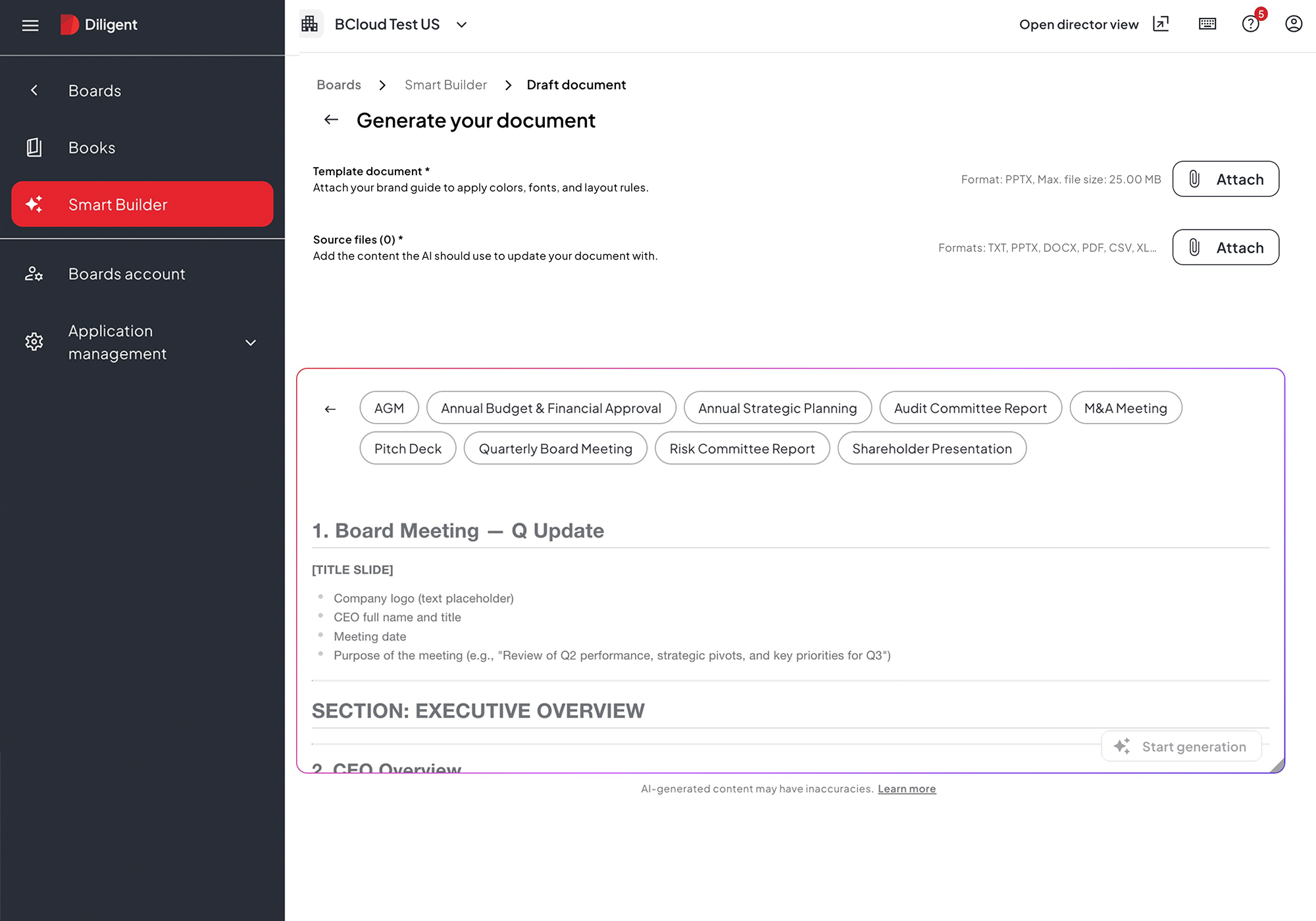
For boards managing enterprise risk oversight, Diligent ERM provides comprehensive risk intelligence with Moody's benchmarking and board-ready reporting that connects risk data directly to strategic decision-making.
The platform centralizes risk information from across the organization, enabling boards to see emerging threats in real time and receive executive dashboards that translate complex risk data into actionable insights.
Effective boards balance strategic oversight with operational accountability, whether that means defining clear roles, navigating AI governance or strengthening succession planning. The right combination of structure, skills and technology enables directors to fulfill their responsibilities and position the organization for long-term success.
See how leading boards are transforming their governance effectiveness. Schedule a demo to explore Diligent's AI-powered platform.
A board of directors oversees the strategic direction and overall performance of an organization. Its key responsibilities include hiring and evaluating the CEO, approving budgets, setting policy, ensuring legal and ethical compliance and protecting shareholder or stakeholder interests. The board serves as a fiduciary, ensuring the organization stays aligned with its mission and financial goals.
In corporate governance, the board of directors ensures accountability, transparency and ethical conduct. It establishes governance frameworks, monitors executive performance, manages risk and ensures that decisions are made in the best interests of shareholders and stakeholders. The board acts as a critical check and balance on executive management.
Beyond strategic oversight, a board of directors may:
Board member definition: An individual elected or appointed to serve on a governing body guiding an organization’s mission, strategy and performance.
Board members have fiduciary duties, which include the duty of care, loyalty, and obedience, and are expected to contribute expertise, make informed decisions, and uphold the organization’s best interests.
To get on a board of directors:
Board service requires responsibility, accountability and active engagement. Individuals should not serve on a board if they:
The board sets the tone at the top and ensures that the organization’s values align with its actions. Ethical considerations are the board’s responsibility in situations involving:
Overboarding refers to a situation where a person serves on too many boards, limiting their ability to effectively fulfill their responsibilities. Governance best practices often recommend limits — for example, no more than three public company boards for a sitting CEO. Overboarding can reduce meeting attendance, engagement and overall effectiveness.
The board of directors sits at the top of the organizations they serve. This comes with an elevated profile and respect that brings numerous personal, professional and community gains. Some key benefits of being a board member are:
Removing an entire board of directors is rare and typically requires:
A report for a board of directors should use a formal, concise and executive-level writing style. It should focus on clarity, data-driven insights and strategic implications, and the tone should be professional and neutral. Avoid jargon, but use precise language. Key elements often include:
From board reporting to strategic oversight, Diligent helps directors fulfill their responsibilities with greater clarity and efficiency. Request a demo to explore the platform.